

Celebrating the Graduation of the Chicago Peace Fellows
By Ethan Michaeli, Senior Advisor for Communications

For Velvian Boswell, being a Chicago Peace Fellow transformed the way she saw her own neighborhood. Speaking to a room packed with family, friends and supporters at the Peace Fellows’ graduation, Boswell, who works as a recovery specialist for the Chicago Women's AIDS Project, recalled the component of the curriculum in which they were asked to create asset maps of their own neighborhoods. In the beginning, Boswell didn’t think there were many assets in her community, Englewood on the city’s South Side.
“At first, I thought of all the liquor stores,” Velvian said, “but I had to take a step back.”
“We have a lot of history, a lot of people, and a lot of resources in Englewood. That is what I learned as a Chicago Peace Fellow.” -- Velvian Boswell
Boswell was just one of 18 grassroots organizers who graduated from the first cohort of Chicago Peace Fellows on November 14 at an event space on Division Street in the Wicker Park neighborhood. Each of the Fellows lives and works in neighborhoods dealing with disproportionate rates of crime and violence, and they celebrated months of work sharing their experiences, learning new techniques, and expanding their networks as well as acquiring new contacts and resources.

The Fellows will join the Goldin Institute’s international cohort of grassroots organizers around the world who are developing innovative strategies for empowering their neighbors and fostering healing in areas torn by war and natural disaster. The Peace Fellows were trained through GATHER, which is both a software and a curriculum designed by the Goldin Institute to facilitate peer-to-peer learning.
“This is one of those moments when life comes full circle,” said Travis Rejman, the Goldin Institute’s executive director, introducing the Peace Fellows at the event.

Travis described the Goldin Institute’s origins in 2002 during a week-long conclave in Chicago that brought together an unprecedented roster of grassroots organizers from around the globe. Participants studied the city’s rich history of community organizing, and shared the wisdom they had acquired in their work in different cities before collectively conceiving of an organization that could help grassroots organizations foster conversations, build their networks, and tap new resources.
“We’ve been pursuing those principles and putting them into practice over the last 17 years in over 50 countries. The key to our mission to create spaces for grassroots leaders to learn and work together so they can connect around issues they care about and collaborate across borders.” -- Travis Rejman
The Peace Fellows program, Travis explained, was built on the lessons learned through these years of work and especially through the international GATHER Fellows. The asset map Velvian described is just one of the exercises designed to “understand power, privilege and race, and the intersectionality of how those forces intersect with our peace building.” All of the components of the curriculum were calibrated to “center voices of those who are often excluded, knowing that those who have the most at stake and the most wisdom.”

Overall, the Peace Fellows participated in 50 workshops, trainings and meetings with civic leaders, at least one event every two weeks and many weeks with multiple events. In addition to the shared learning sessions, the Peace Fellows collaboratively planned 8 projects in the summer and beyond with special funding from the Chicago Fund for Safe and Peaceful Communities.
“Over the past 17 years working in over 50 countries, we’ve seen that real and sustainable change is always rooted in the power of communities building on their assets and inviting voices people on the front lines to make decisions,” Travis said.
Goldin Institute Program Coordinator Burrell Poe praised the Peace Fellows for their dedication and assiduity, and welcomed them into the “community of practice” with the GATHER Fellows. An organizer himself, Burrell said the mutual support was essential for effecting change.
“It’s really about how do people who do the work stick together, how do they support each other,” Burrell said.
“At the end of the day, if I’m someone who’s working hard in Englewood, it’s nice for me to know someone who’s working hard in Austin. That connection is powerful because we’re doing the work in our own communities and sometimes we can feel so alone and being together a community of practice is so important.”
Peace Fellow Frank Latin, the founder and executive director of Westside Media Project, recalled one workshop at the Institute for Non Violence Chicago, where they spoke with case workers and others engaging with young men in the community at high risk for being both perpetrators and victims of violence. Many of the case workers have personal experience with street violence, and Frank remembered the conversation as robust and incisive, piercing the myths that cloud the picture of what is actually happening in neighborhood like Austin on the city’s West Side.

“I got to hear directly from people who look, quite frankly, just like me,” Frank said.
“We got to hear directly from people working on the front lines, some of the challenges that don’t make the news, like why are people carrying guns. Not everyone who is carrying a gun in Austin is a predator. A lot of people were trying to protect themselves, but once you get arrested, you’re going to same jail cell.” -- Frank Latin
Frank continued that it as a resident of another neighborhood handling high levels of violence, he knew already that it was a “no brainer necessity” to work with those whose past includes criminality. But often, the prevailing narrative in mainstream media, the academy, and even among social services are wary of direct contact with those most likely to be involved in violence.
“We all come from different points in life and we got to hear from people using resources and what they know in their communities to make a difference,” Frank said.
“We all come together regardless of our backgrounds and what we’ve been through to try and make a better place to live.”
Peace Fellow Dawn Hodges, executive director of Imani Community Development Corporation in South Chicago, talked about the collective planning process for deciding how to fund the summer projects. It took several rounds of very active conversations and lots of sticky notes as well as a few digital tools, but in the end, the Peace Fellows had decided on eight innovative initiatives, each of which involved multiple Fellows.

The summer projects included “Passport to Peace” events, community fairs with peace circles, tai chi classes and other services for community residents, the “Youth Exchange,” an overnight retreat at a Wisconsin camp site for young people from different neighborhoods, and a retreat for the Peace Fellows themselves, a rare opportunity to reflect and discuss.
“The powerful part was those who got funded less but needed more and those who got more we all ended up sharing, so all the projects that were going to be funded got funded,” Dawn explained.
Maria Velazquez, executive director of Telpochcalli Community Education Project in the Little Village neighborhood, admitted that she was not particularly tech-savvy when she received the iPad preloaded with the GATHER software. But she quickly got help both from the Goldin Institute staff and from other Peace Fellows.
That sense of camaraderie was key to the GATHER curriculum’s success for Maria. After 17 years at Telpochcalli, a mostly volunteer organization, she focused on learning new techniques that will make collective decision more effective. But overall, Maria was thrilled to find a new cohort of peers with whom she can share her experiences and challenges.
“Often, we feel very isolated like we are the only ones doing it. Now I have a team of people I can turn to.” -- Maria Velazquez
The event continued with comments from other Fellows as well as supporters including Conant Family Foundation Executive Director Leslie Ramyk, who collaborated closely with Travis to fund the first class of Peace Fellows and pledged to do what she could to make sure there would be additional cohorts.
"Thank you for being the inaugural Chicago Peace Fellows. I’m so excited with everything that happened this year. The least I can do – and what I must do – is raise the money so we can do this again.” -- Leslie Ramyk, Conant Family Foundation
The graduation celebration closed with a rousing – if slightly off-key – group sing-along led by Peace Fellow Gloria Smith, who wrote new lyrics under the title “We are building up a new world” to the tune of the traditional song “Jacob’s Ladder.”
The Goldin Institute thanks the Conant Family Foundation, the Polk Bros. Foundation, Chase Bank, the Partnership for Safe and Peaceful Communities and our generous network of champions for community driven social change for supporting the Chicago Peace Fellows
Download the Graduation Booklet to Learn More


Testimony and Transformation
The weekend of October 12-13, the Goldin Institute partnered with the Voices & Faces Project and Brothers Standing Together, an organization founded by GATHER alumnus Raymond Richard, to lead “Testimony & Transformation: A Writing Workshop for Returning Citizens.”
Hosted at the Samuel DeWitt Proctor Conference in the Chicago Defender building on the city’s South Side, half a dozen formerly incarcerated men from throughout Chicago as well as Milwaukee, Wis., came together over two days to explore their respective journeys through the justice system with its consequential legacies.
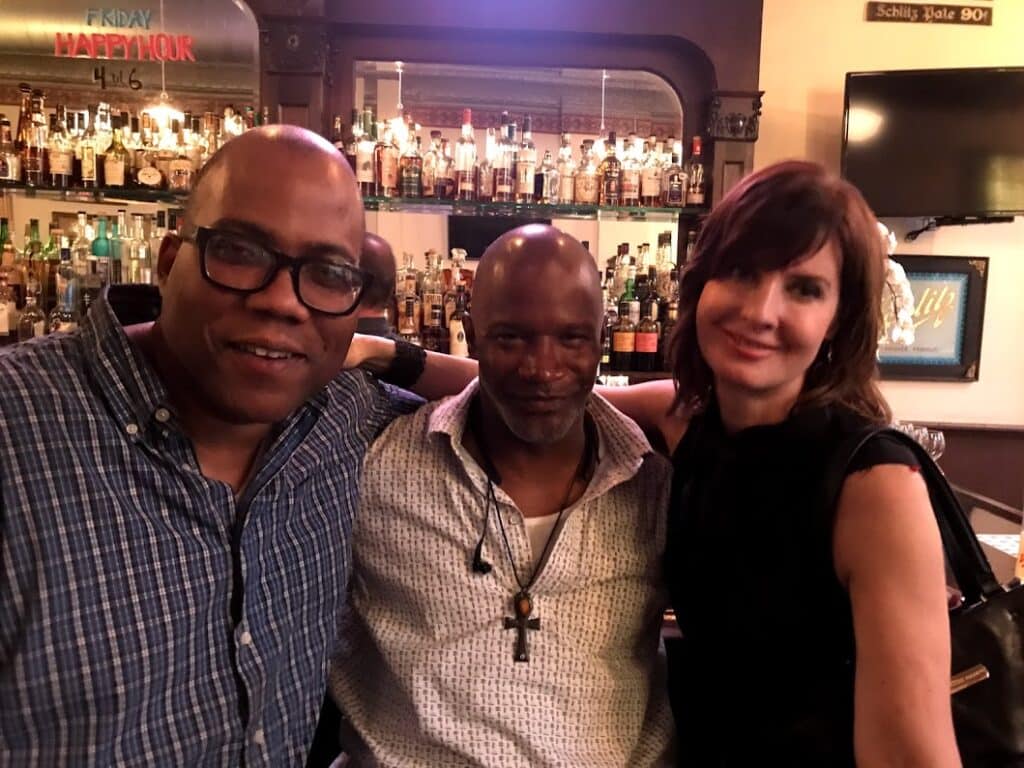
The workshop included writing exercises in multiple genres, including essay, spoken word poetry, personal letter, and short story. Readings by Paul Laurence Dunbar, Huey P. Newton, Nelson Mandela, and Angela Y. Davis informed provocative conversations. Al, a local spoken word artist, visited as well.
Co-facllitated by the Goldin Institute’s Jimmie Briggs with R. Clifton Spargo, an author and creative writing instructor who has taught at both Yale University and the renowned Iowa Writers’ Workshop, the program is supported by funding from the Illinois Humanities Council.
The effort is the first of a series of organizational collaborations to support alternative narratives about mass incarceration, policing and restorative justice through the written words of those directly impacted by inter-generational trauma, poverty, and under-employment. The next workshop will be a one-day training at the Sargent Shriver National Center on Poverty Law, 67 E. Madison St., suite 2000, in Chicago’s Loop on January 11, 2020.
A public reading and performance by workshop participants from both the October 2019 and January 2020 sessions will be mounted in Chicago in February 2020.
Details and application materials are forthcoming, but interested organizations and individuals should check the Voices & Faces Project website in early January 2020: www.voicesandfaces.org.

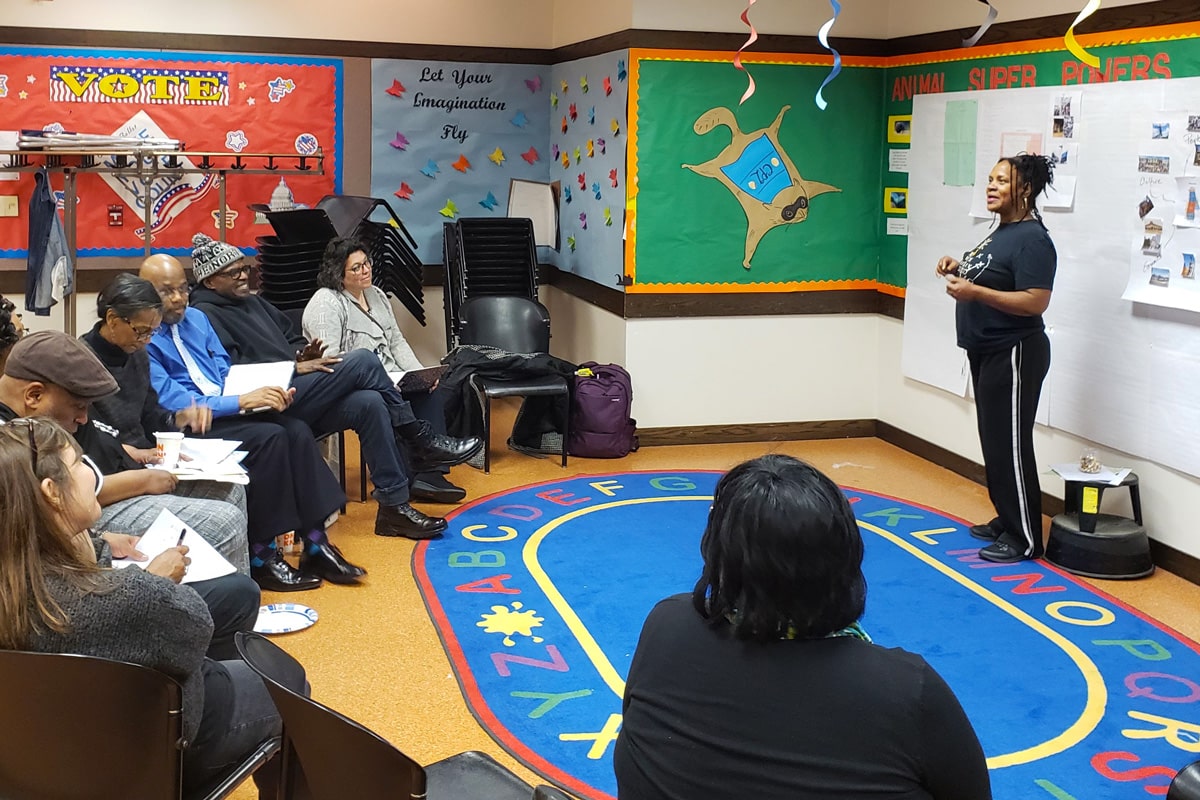
Partnering with DePaul's Technology for Social Good Lab
One of the Goldin Institute’s core values is to build partnerships that are rooted in the power of communities working together to build solutions that can help generate local social change. The Chicago Peace Fellows have done this throughout the 2019 GATHER course, working to build community not only within their neighborhoods, but also among themselves and with civic partners throughout Chicago.
As part of the GATHER course, the Chicago Peace Fellows generated Asset Maps of their neighborhoods, asking friends and neighbors what they considered “assets” in their communities. After coming together as a cohort to discuss all the assets they identified in the 14 neighborhoods in which they work, a larger discussion was initiated around a “Living Asset Map” that could be city-wide, connecting grassroots leaders and nonprofits throughout the city with each other and like-minded organizations as well as other institutions and public leaders.

To move this conversation forward, the Goldin Institute has partnered with Dr. Sheena Erete at DePaul University's Technology for Social Good Lab to research and prototype a digital version of a shared asset map of the 19 Community Areas designated for grants by the Chicago Fund for Safe and Peaceful Communities. Three undergraduate students sponsored by DePaul’s Steans Center will be joined by three graduate students to design an interface that supports asset-mapping by Chicago grassroots leaders and their communities.
The undergraduate students from the Department of Geography will use their expanding technical skills in digital map-making, incorporating data from the city as well as from the University of Chicago Crime Lab and the Metropolitan Planning Council to create base maps for each area before digitally adding the assets identified by the Peace Fellows during their progress through the GATHER course.

The three graduate students will work with the Technology for Social Good Research and Design Lab, where Dr. Erete is the director, to engage community organizations across Chicago in interviews and design workshops, enhancing the base maps created by their undergraduate teammates as a prototype an interactive digital tool that can connect grassroots leaders, increase their collaboration, and act as a citywide tool for peace building. Their work will begin this semester and stretch into summer 2020.
“We are excited to collaborate with the Goldin Institute because the Chicago Peace Fellows' work is rooted in their communities and leverages local assets, which we believe is the only way to grow and sustain healthy communities.” -- Jessa Dickinson, doctoral candidate, DePaul University.
During asset mapping workshops held by the Goldin Institute for the Chicago Peace Fellows, the Fellows identified layers not typically found on traditional asset maps. They became specifically interested in mapping less visible, but equally valuable, assets such as the tight networks of friends from demolished public housing buildings who continue to meet for annual reunions near the sites of their former buildings even though they have all been relocated to other neighborhoods, or the impact that a block leader might have on a neighborhood, or physical spaces like closed schools that are not currently in use but could easily be turned into space for after school programs, meetings of community organization, or partnership opportunities.

Encouraged by the relationships that they have found with institutional leaders such as the Chicago Park District and the University of Chicago Trauma Center, the Fellows view this digital map as another item in their expanding toolbox to prevent violence, build peace in their neighborhoods, and make the entire city safer.
Key features of the new digital map’s design will be the ability to capture non-physical assets that exist in each of our communities, a user-friendly interface for grassroots leaders, and public access to add to the collective asset map of Chicago.

Peace Fellows Advisors Review Progress

With the first cohort of the Chicago Peace Fellows finishing their summer projects and nearing the end of their curriculum, the Goldin Institute convened a dinner meeting of prominent advisers on Thursday, September 12, to discuss strategies for sharing the Fellows’ accomplishments and wisdom during their upcoming graduation.

Held at the Erie Café in the city’s River North neighborhood, this was the third advisors dinner, and was attended by Goldin Institute Founder and Board Chair Diane Goldin, GATHER alumnus Raymond Richard, founder of Brothers Standing Together, a Chicago-based non-profit organization; Leslie Ramyk, Executive Director, Conant Family Foundation; Teresa Zeigler and John Zeigler, director of DePaul University’s Egan Office of Urban Education and Community Partnerships; Mimi Frankel, a member of the Frankel Family Foundation’s Board of Directors and the Goldin Institute’s Board of Advisors; Lisa Dush, a DePaul University professor who is conducting an academic evaluation of GATHER; Justice Stamps, who runs the Marion Nzinga Stamps Youth Center mentoring program on the Near North Side; José Rico, a Director of Truth, Racial Healing and Transformation for Greater Chicago; Rob Rejman, vice president, Ascent; as well as Goldin Institute staff led by Executive Director Travis Rejman, along with Oz Ozburn, Jimmie Briggs and Burrell Poe.
The Goldin Institute team began with an update on the many workshops and events that the Peace Fellows have participated in, including the strategy session with the Crime Lab at the University of Chicago, the exploration of the role of urban planning and design in building safe communities with Studio Gang and the Rebuild Foundation and the meeting with Alderman Burnett on how grassroots leaders can more effectively collaborate with city-wide initaitives.
All the participants framed the Peace Fellows’ work in the context of the continuing unacceptable levels of violence in some Chicago neighborhoods. Jose Rico spoke about the Truth, Racial Healing & Transformational Initiative as well as about regular meetings in the office of Chicago’s newly elected Mayor Lori Lightfoot, and how the Fellows’ work could inform their discussions.
The Conant Foundation’s Leslie Ramyk said Chicago’s philanthropic leaders were mobilizing beyond their daily duties to respond to the crisis, including collaborating to publish a recent Op Ed, Enough With Hate, in Crain’s Chicago Business. Many family foundations are responding to the violence, moreover, by seeking out and listening to community leaders, using their leverage, power and privilege to try and make the social standard more equitable.
[quote]“This is outside of our job descriptions. We do it because of the necessity of this crisis.” -- Leslie Ramyk, Conant Family Foundation[/quote]
Mimi Frankel of the Frankel Family Foundation observed, “We are dealing with a totally different environment than we have had before.”
Goldin Institute Executive Director Travis Rejman talked about the importance of building a movement of connected peace-makers and quoted the maxim, "Great leaders don't inspire movements, movements inspire great leaders."
Senior Adviser Jimmie Briggs suggested building interest from journalists in the Peace Fellows’ efforts through various efforts, including a panel discussion. As a New York-based writer with roots in the Midwest, Jimmie was enthusiastic about the potential for the Fellows’ stories to reach a broad audience.
[quote]“Visiting this city can feel like you're in different countries as you go from neighborhood to neighborhood. Some areas are safe and some aren't and you can live in this city and have fully different experiences.” -- Jimmie Briggs[/quote]
He added that a narrative encompassing all the Peace Fellows’ diverse experiences would be inspirational. "If there is no narrative out there, it didn't happen," Jimmie cautioned.
Program Coordinator Burrell Poe said that when he was interviewing Fellows, one of their most common requests was to meet others doing similar work. Now that the program is up and running, he was proud to have facilitated the Fellows’ early contacts and that they are now working closely together.
“They are really loving it,” Burrell said of the Fellows’ collaborations.
DePaul University’s Lisa Dush, who is conducting an evaluation of the fellowship, said her challenge was to adapt available metrics to accurately measure results. While data is available to indicate the Fellows’ progress through the curriculum, she wants to make sure she documents the true picture of their experience.
John Zeigler discussed changing the prevailing narrative of the city’s communities, and change the focus of philanthropies, who tend to make grants to programs which generate quick results, rather than long-term investments.
John asked, “How do you challenge or disrupt that narrative?”
[quote]“Chicago is a city of neighborhoods but it is also a city priding themselves on growing organizers.” -- John Ziegler, DePaul University[/quote]
In that vein, John was pleased the curriculum had fostered meaningful and productive connections among the Peace Fellows.
“The Chicago Peace Fellows build trust and social capital with each other,” he said. “Social capital is a process, and the Chicago Peace Fellows invests in the process.”
Raymond Richard of Brothers Standing Together spoke about the responsibilities of community leaders, including non-profit executives, to work in concert and demonstrate dignity to younger generations. Philanthropies will have to be involved through determined strategies, he continued.
“These kids are fighting the same fight and they don't even know it,” Brother Ray said.
[quote]“If we're going to break down a barrier, we have to lead by example. We don't want the children to know how much we know. We want them to know how much we care." -- Raymond Richard, Brothers Standing Together[/quote]
Peace Is a Journey, Not a Destination

On a balmy and breezy Saturday in early September, the fragrance of peace filled the air. The scent of patchouli and music of meditation greeted more than 200 residents as they entered Cooper Park located in the historic Maple Park neighborhood on Chicago’s far South Side. They journeyed to this urban ashram for a “Passport 2 Peace.”

Through a series of strategic, community engagement conversations, Maple Park residents acknowledged that community safety was their number one quality of life concern. Out of these conversations, a local design team was created composed of residents, the Maple Park Neighborhood Association, Chicago Police 5th District CAPS, the Chicago Park District and area communities of faith, and it was out of this team that a “Passport 2 Peace” was born. Significant collaborative input from the Goldin Institute’s Chicago Peace Fellows and the Chicago Alternative to Incarceration (ATI) Collaborative’s Neighborhood Interns helped shaped the event. The Maple Park Passport 2 Peace Neighborhood Summit is one of 3 such events in different locations on the South Side.

The concept behind the Passport 2 Peace is that peace is an “inside job” that begins within each of us. The Passport 2 Peace is an inward journey to promote the place of peace that resides in every person and an outward journey to build community. Massage therapy, mediation, yoga and tai chi demonstrations and reflexology stations staffed by certified experts provided the tickets on the journey to inner peace. One participant remarked, “It was amazing to see children doing tai chi.”

As participants moved from station to station, Peace Ambassadors clad in sky blue t-shirts applied stickers to individuals’ passports and served as hosts for each activity. The children played on the playground and did face painting while the adults explored their inner peace. After sharing a community meal to promote community peace and facilitate relationship building, more than 50 people participated in three Inter-generational Peace Circles led by Nehemiah Trinity Rising, a grassroots consultancy specializing in restorative practices leadership training.

On the Sunday prior to the Passport 2 Peace, a Peace Makers’ Sabbath Celebration was held at Maple Park United Methodist Church. The event organizers were invited to come and pray for peace. The Peace Makers’ Sabbath encouraged participants to pray, preach and act for peace. Passport 2 Peace was the action step.

Passport to Peace Draws Together 200 Neighbors

On Saturday, September 7, the Chicago Peace Fellows gathered in Cooper Park in the West Pullman community on the Far South Side to spread peace. Hosted by Pastor Robert Biekman, this event was the second of the Passport 2 Peace series, one of the Chicago Peace Fellows’ summer projects. Each event in the series is being held in a different community but all include peace building activities such as intergenerational peace circles, yoga, mediation and entertainment. The final event will be held Saturday, September 28.

The Cooper Park event was attended by over 200 community residents who participated in activities such as Tai Chi, reflexology and meditation. Each guest received a “passport” with the task of visiting booths and participating in the activities, which would earn them a stamp. One Peace Fellow, Robin Cline, came very close to visiting each activity, and many at the event went from station to station learning more about what peace feels like.

Fellow Gloria Smith, executive director of the Black Star Project, commented, “I loved every minute of it, including the tai chi exercises and the intergenerational peace circles. I also really enjoyed the camaraderie among the people in attendance.” Gloria was part of the planning team for the event, and worked closely with Robert to put the event together.

Robert noted that several years ago, the Cooper Park playground had been the location of a horrific incident in which two young men were shot. Because of that incident, the park was saddled with a reputation as a violent place and many neighborhood residents refused to utilize it. Robert envisioned hosting Passport 2 Peace in the park, therefore, to challenge that narrative and have people actively think about peace in that park.
“Passport 2 Peace exceeded our expectations!” Pastor Biekman reflected.

Peace Fellows Tour University of Chicago Crime Lab

On Friday, August 30, the Chicago Peace Fellows toured the University of Chicago Urban Labs to learn more about the work of the Crime Lab, hosted by Kimberly Smith, associate director of criminal justice initiatives.

Kim talked about how the Crime Lab started with the idea to leverage the intellectual capital of the University of Chicago to address violence in Chicago. In 2007, the University was reeling from the shooting death on their campus of an international student during an attempted robbery. Their solution was to ask what the University’s faculty members were good at and how could they use their talents to serve their surrounding community.
[quote]The University of Chicago is the home of more Nobel Prize winners than any other institution in the world, and the school is a hub for research of many kinds, scientific to historical. Could they use those techniques to encourage research on the causes and solutions to violence in the communities that surround the university?[/quote]
They began to work with community organizations to add value by providing research and evaluation support. They identified one organization that was producing tremendous results and helped them grow their programming, and they are working with several other groups across the city that are tackling issues of violence in the city to identify effective strategies.

Much of the meeting was spent fielding questions from the Chicago Peace Fellows about how the Crime Lab does its work. They asked about the Crime Lab’s work with the Chicago Police Department, particularly how the Crime Lab is working to support officers and their relationship to the community. Robert Biekman wanted to know about the Crime Lab’s analysis of the federal consent decree that is designed to change the policies and procedures of the Chicago Police Department.
Dr. Sokoni Karanja asked about accessing data on community policing programs, which began a conversation about data sharing and how the Crime Lab provides data to grassroots organizations to measure impact. Many of the Chicago Peace Fellows have been doing tremendous work in their respective communities for years and were open to utilizing the support of the University's researchers to document their efforts and learn more about what’s most effective.
The meeting was a great demonstration of how communities can work with institutions to solidify best practices and identify promising solutions to the myriad of issues that communities across Chicago face.
The Role of Urban Planning and Design in Building Safe Communities
How can architects and urban planners work with grassroots activists to make neighborhoods safer?
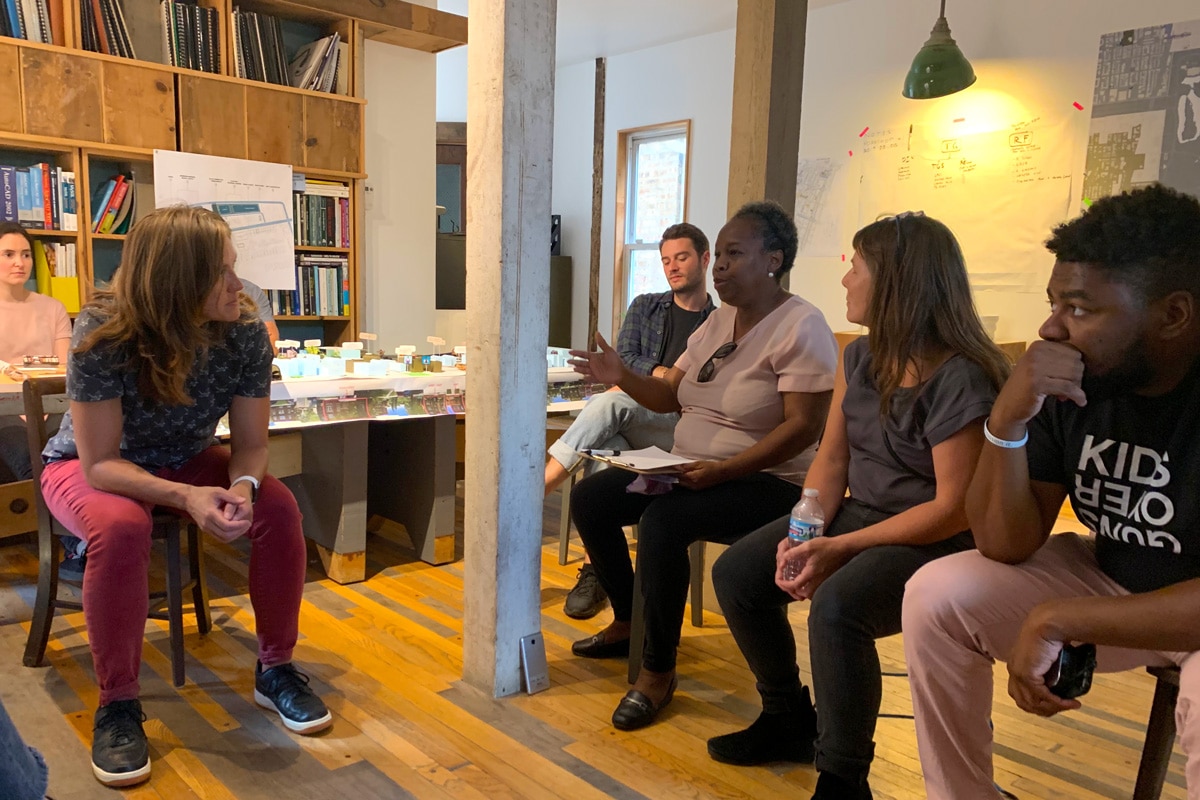
That was one of the topics of a deep and wide-ranging conversation on August 27 between several Chicago Peace Fellows, Mallory McClaire, chief of staff of the Rebuild Foundation, and Gia Biagi, principal of urbanism and civic impact at famed architectural office Studio Gang.

The discussion took place at the Stony Island Arts Bank, a historic financial institution on a main boulevard in the Grand Crossing neighborhood on the South Side that had fallen into disrepair, but was rehabbed into a gallery space, archives and community art center.
While the Fellows ate lunch, Gia began the meeting with a presentation of several projects she and her team had completed in which they explored the assets that community anchors and public spaces can become when cities and citizens invest in collective urban life. She reviewed two projects, Reimagining the Civic Commons and the Mayor’s Office of Criminal Justice: Neighborhood Activation Study in New York, both of which look at civic assets like parks, libraries, and schools as more than physical spaces, but as opportunities for social transformation and inclusion.

Mallory gave an overview of the Rebuild Foundation, a platform for art, cultural development, and neighborhood transformation. Founded by Chicago-born artist Theaster Gates, their projects seek to strengthen communities by offering free arts programming, creating cultural amenities within the neighborhood, and developing affordable housing and work/studio space for local residents.
The Rebuild Foundation’s work is informed by three core values - Black people matter, Black spaces matter, and Black objects matter. -- Mallory McClaire
The Rebuild Foundation recently hired Studio Gang’s Urbanism and Civic Impact team to create a strategic plan to leverage the properties they own to collectively improve the lives and livelihoods of the neighborhood residents.

After these presentations, Mallory led the Fellows on a tour of the Stony Island Arts Bank, where they sat in the original leather chairs preserved from the office of Ebony/Jet Founder and Publisher John H. Johnson, reviewed the enormous Johnson Publishing Book Archive, and admired legendary DJ Frankie Knuckles’ record collection. Mallory took the Fellows to a special room where a collection of racist memorabilia and propaganda had been collected and tucked away in drawers, to be reviewed only during facilitated discussions. Fellows compared this alternative display technique with the Field Museum’s Sculptures of Mankind exhibit they viewed and discussed with staff at that institution recently.

The Peace Fellows solemnly visited the exhibit Objects of Care: Material Memorial for Tamir Rice, the gazebo in which the 12-year-old Tamir Rice was playing when he was shot to death by a Cleveland police officer in 2014. Having fought against the gazebo’s demolition, Samaria Rice, Tamir’s mother, requested that the Rebuild Foundation preserve it as a space for community care, dialogue, and public engagement.

Mallory and Gia then took the Fellows on a tour through the neighborhood, stopping at the buildings renovated and owned by the Rebuild Foundation. The first stop was the Dorchester Community Garden, a public garden space created in partnership with the Rebuild Foundation and NeighborSpace. As children ran through the raised planters and climbed on the built structures, Peace Fellow Robin Cline, assistant director at NeighborSpace, talked about the history and creation of the garden and the impact it has had on the neighborhood.
“A successful space depends so much on the eyes on the space and the commitment to welcome people to sit in these public spaces. We’re going to program the spaces, make the spaces have meaningful activity, and we’re OK with people using the space the way they might want to use it.” -- Robin Cline
The group then gathered around snacks and beverages at Rebuild’s “Listening House” and toured the on-site workspace Studio Gang set up. They also reviewed a model of an asset map of Rebuild and the surrounding neighborhood. Amidst precedent images, working models, and sketches, the group discussed the potential to use the tools and insights of urban planning and civic design to create impact through the built environment and how it could influence their own work.
Fellow Sokoni Karanja talked about the grassroots peace-building efforts in his neighborhood near Washington Park. He relayed to the group how organizing Saturday street cleanings, organizing tenant unions and block clubs, creating several community phone trees, and getting commitments from local citizens and business owners recently helped reduce violence in his neighborhood from 27 homicides in 2016 to 2 so far this year.
“I think violence prevention may be the ultimate goal of our initiative, but really what we want is community cohesion and developing norms of what the community will and will not tolerate. That’s really where the impact will come from. Violence prevention stems out from that.” -- Sokoni Karanja
Mallory spoke about Rebuild’s history as an organization built by an individual’s desire to invest in his own community. Theaster Gates grew up in Chicago and continues to live in the neighborhood, desiring to be an example of what it means to invest in your community. Rebuild has found that their neighbors want transparency as well as a pathway to engagement.
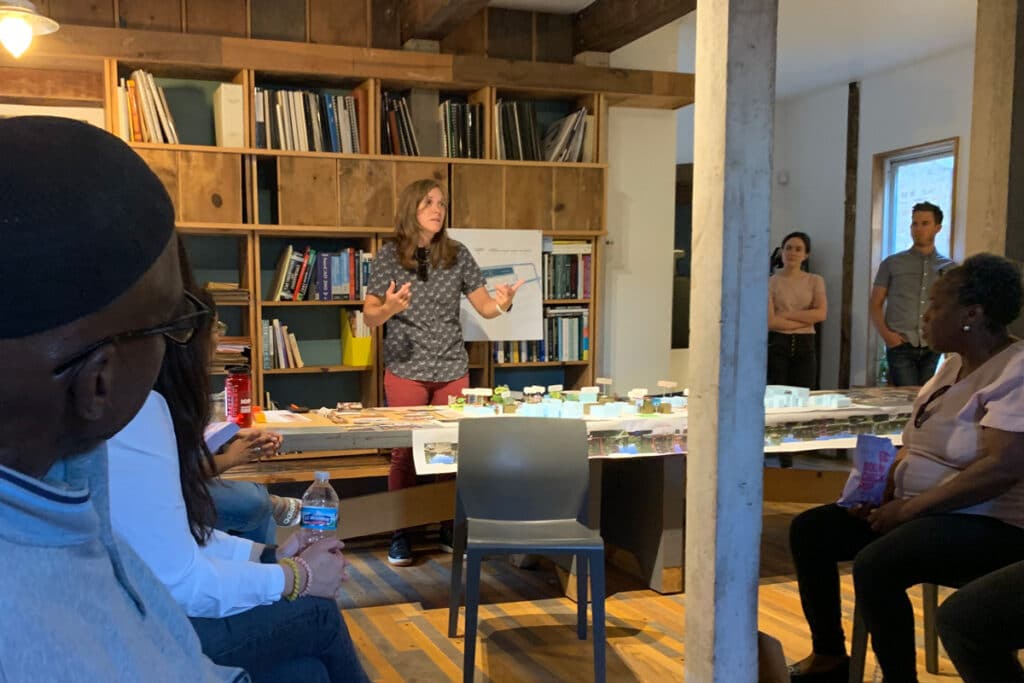
Fellow Jackie Moore said that invitation was all the more important because Greater Grand Crossing has a low percentage of home ownership. When she drives up and down streets in her community, some are pristine and others are not, and almost always, the condition of the street has a direct relationship to whether people own their homes.
When I own the land, I don't need to wait for permission. I don’t think it’s from lack of interest, or lack of design. I think it’s from lack of agency. When you own something, you don’t wait for others to take care of it. When you design spaces with the assumption that they will take care of what has been designed for them, you open yourself up to more opportunities.” -- Jackie Moore

The meeting concluded with a discussion of resources, grants, land trusts and Tax Increment Financing districts - mechanisms that have been set aside for community development - as well as who has figured out how to leverage these resources. The Fellows agreed that urban planners like Gia and her team, and developers and organizations like Rebuild Foundation are potentially good partners for grassroots leaders who are daily making change in their neighborhoods. In addition to well-designed public spaces and informed public policy, planning and design tools can help support the visualization of goals, creation of processes, and leveraging of assets in the work of peace building in our physical environment.
Peace Fellows Explore Decolonizing Philanthropy with Edgar Villanueva

In his book, “Decolonizing Wealth: Indigenous Wisdom to Heal Divides and Restore Balance,” Edgar Villanueva makes a strong and needed critique of traditional philanthropy. In many ways, his analysis is similar to that made by my late brother, Phillip Jackson, who was the founding director of the Black Star Project.

Phillip was an important inspiration to Edgar, and Phillip’s influence is powerfully reflected in the book. In 2016, my brother led a major local and national campaign taking the foundation world to task for policies that have exacerbated the extraordinary poverty of communities of color in the richest nation in the world.
As one example, Phillip decried as “modern-day redlining” the tiny percentage of grants to Black organizations from the Chicago-based John D. and Catherine T. MacArthur Foundation. He believed that funders ought not to pat themselves on the back if they are unwilling to acknowledge and provide direct support to the Black and Brown communities that continue to suffer in the margins of the great wealth in this city and country. This wealth, after all, was made possible by public policies that disenfranchised people of color and kept our neighborhoods poor and vulnerable.
[quote]Edgar read about my brother’s work as he was writing his book and interviewed Phillip as part of his research. Unfortunately, Phillip passed away November 4, 2018, before the two men could meet in person.[/quote]
But from his family home in North Carolina, I recently had the great pleasure of meeting Edgar during a video roundtable that included the current cohort of Chicago Peace Fellows (of which I am a member), the international alumni of GATHER, and several staff of the Goldin Institute. Since my brother’s passing, I have continued his work as the executive director of the Black Star Project and I am certain that Phillip would be delighted and proud of Edgar’s vision for a new approach to more fairly and humanely distribute the tremendous wealth of foundations in this country.

Part one of “Decolonizing Wealth” addresses how philanthropy mirrors colonialism, sometimes doing more harm than good, and the importance of hearing the stories of colonized people with a respectful and open heart. Within the chapters of part two, Edgar outlines seven critical steps—Grieve, Apologize, Listen, Relate, Represent, Invest and Repair—to healing centuries-old trauma. He asks: 1) What if money could be medicine instead of what divides us? and 2) What if, rather than using wealth to cause further harm, we followed these “Seven Steps to Healing?”
During our roundtable discussion on August 23rd, Edgar talked about how indigenous wisdom has shaped his life and perspective on philanthropy. Chicago Peace Fellows Robert Biekman asked about the role of spirituality in philanthropy, and Dr. Sokoni Karanja, who attended a peace walk with Edgar many years ago, asked if social workers today should take a more activist/organizing roles in philanthropy. International GATHER alumnus Yusuph Masanja received advice on managing a fundraising issue.
Edgar acknowledged the good work of all of the Fellows and offered some recommendations for the use of restorative justice and methods of truth and reconciliation in their efforts. He also encouraged Fellows to build personal relationships with funders as they move forward together.
Edgar Villanueva understands decolonizing as a lifelong journey, and is thankful to his Native elders and to those who came before him, like Phillip, who shaped his early thinking on what philanthropy should and can do to right historical wrongs.
It was my great joy to meet him and to learn from his thoughtful and stimulating new book!

Chicago Youth Exchange Builds Trust in the Great Outdoors

Six thirty a.m., Sunday morning, teens ages 15-21 wait in great anticipation for the bus that will take them away from the Windy City, Chicago, with the bright lights, loud noises to the serene shores of Lake Geneva, Wisconsin - the Outdoor Wisconsin Leadership School (OWLS) in Williams Bay, Wisconsin.

[quote]For many of the youths, this is going to be their first experience camping and the questions are non-stop, from “What type of bus will we ride on?” to the physical layout of the facility, all of which I can’t answer since this is my first experience camping as well.[/quote]
During our initial encounter as Chicago Peace Fellows, several of the fellows talked about their work with young people during the summer and the possibility of hosting an overnight camping trip for youths from the various communities. As one of the eight funded summer projects, the cohorts from the New City, South Shore and Little Village communities collaborated on a Youth Exchange 3-day camping trip which would allow black and brown youths from the various communities to get to know one another, explore similar experiences, and create an ongoing bond which would facilitate additional collaborative activities.

The Outdoor Wisconsin Leadership School welcomed our group with open arms. They excitedly celebrated our arrival as they asked the youths to settle in and grab lunch because then it was activities planned from the moment we arrived until the time we left. Our first afternoon began with building trust activities. The youths were divided into three random groups, each decided on a name for themselves, and then continued on with activities accordingly. Activities included talking circles, trust exercises, high ropes, low ropes and general recreational activities. On Monday, the youths participated in rock climbing, archery, fishing, swimming, canoeing, nature walks and sports and recreation. All the activities were geared toward establishing a bond among the youth. And what's a camping experience without a night adventure walk and toasting marshmallows by the campfire?
In addition to the relaxation and fun, the youths were challenged to address life challenges and, in some cases, had emotional moments related to their personal fears and frustrations as well as mistrust. Some recounted criminal activity and family involvement with DCFS. The opportunity to address the youths in these situations proved to be a rewarding experience for both the youths as well as the Fellows, who assured the youths there were adults who were there for them to help them on their journey. In some cases, youths were purposefully invited due to the overburdensome responsibilities they faced as older siblings. The opportunity to be among their peers away from the city and a break from their home life was most rewarding.

Fellow Pamela Butts was the coordinator for the event, and she was exceptional in her leadership skills and generosity to make sure the youth had a pleasant experience, nothing lacking. Several of the OWL counselors expressed how their lives were changed by having someone take the time with them to show them a different path such as what we were doing, and applauded us for our efforts. The experience resonated with them so much that they returned to become counselors after having the experience as a youth participant. Before we left, several of our youths also expressed a desire to learn more and possibly apply to work with the camp next year.
Our thanks also goes to Burrell Poe, who made sure every youth had a backpack and flashlight for their journey. Collaborating with the Chicago Peace Fellows has opened so many doors for the residents of Chicago, and given these youths opportunities they would not have otherwise experienced. I would also like to thank Fellow Gloria Smith, who provided Chicago Sky tickets which we were able to offer some of our youths who were unable to attend the camping trip.
Overall, we will continue to “Change the culture and break the cycle of violence” in our communities by providing positive opportunities for youth to strive toward productive citizenship.
