

LOV Day 2023 Instills Purpose, Passion, and Perseverance
By: Zeki Salah, Communications Associate
On Saturday, February 11th, 400 self-care boxes were distributed to 400 girls across the neighborhoods of Bronzeville, Englewood, North Lawndale, and Austin areas. The boxes were distributed by Ladies of Virtue as part of their 3rd annual celebration of LOV Day. LOV Day was sponsored by the Chicago Peace Fellows Mutual Aid Collaborative as a partnership between 2019 Chicago Peace Fellows, Jamila Trimuel, Executive Director of Ladies of Virtue, and Dawn Hodges, Executive Director of Imani Community Development Corporation. Ladies of Virtue is a Chicago-based non-profit founded by Jamila in 2011 with the goal of becoming the premier mentoring and leadership training organization for Black girls in the world. LOV Day was established in 2021 to further their mission “to instill purpose, passion, and perseverance in girls, ages 9 to 18, while preparing them for college, careers and to become change agents in their communities."

Ladies of Virtue is a mentoring and leadership program for girls, ages 9 to 18. Over the last 11 years they have served over 2,000 girls and families. LOV matches their participants with mentors and prepares them for leadership through our culturally relevant character building, career readiness and civic engagement curriculum. The team at Ladies of Virtue provides project management, collaboration and communication training via their two to four-month project experiences to empower girls to lead in the modern workforce. After graduating from high school, with successful completion of LOV’s leadership program, participants are mentored and supported for six additional years, from 18 to 24, as LOV 4 Life alumni.

LOV Day was a community effort, obtaining funding from the Peace Fellows Mutual Aid Collaborative, drawing in fifty-five volunteers from 12 Corporate/Community Partners, and hosting events in six different schools and community centers. Jamila brought the proposal to fund LOV Day to the Mutual Aid Collaborative alongside 2019 Peace Fellow, Dawn Hodges.
The Mutual Aid Collaborative consists of 74 Black and Brown leaders and committed allies who live and work in the communities they serve on the South and West sides. They have raised over $100,000 to support several active projects. The Mutual Aid Collaborative met and collaboratively voted in January to provide LOV Day with funding to support the distribution of LOV Boxes filled with self-care items. Each LOV box included a teddy bear, chocolates and candy, a painting kit, hair care products, and Black history facts.

LOV Day served as a way to celebrate both Black History Month and Valentine's Day. Themes of Black history and culture were interwoven with the idea of providing girls with the space and opportunity to rest and care for themselves. LOV Day featured a self-care experience called “Black Girls Rest”. This event served 100 girls, twice as many as the previous year. Black Girls Rest included workshops on how to maintain healthy hair, skin care, and feminine care. Hair care stylists, cosmetologists, aestheticians, and an OBGYN all attended to provide guidance. Speaking to the themes of Black history and rest, one Lady of Virtue stated, ”All throughout Black history, slavery and during the Great Migration, Black people were constantly on the move and still to this day heavily dipped in GRIND culture. We need to STOP and REST.”
While 2022’s LOV Day centered more around the distribution of boxes, this year’s LOV Day focused heavily on programming, with Ladies of Virtue visiting six schools to hold self esteem and confidence workshops. Events include hair and makeup demonstrations, pillow decorating, mental health workshops, feminine and skin care tips, and candle making. The programs were conducted by program facilitators for the Ladies of Virtue and aimed to show Black Girls that they are and should be loved, nurtured, and protected. For instance, one workshop had girls identify what they love about themselves and encouraged their peers to support that expression of self-love.

Jamila attended one of the LOV Day classes where girls were discussing when they were at their best. One girl that Jamila was working with said “Oh I love my smell because it reminds me of how my dad smells,” but then noted “ I really don’t talk about my dad much.” When Jamila asked why, the girl mentioned that he died a few weeks ago. Jamila reflected, “that really let me know that she felt like this was a safe space for her to express herself; that we were establishing a safe space for girls to just be themselves.”
To continue their mission of instilling purpose, passion, and perseverance in girls, ages 9 to 18, while preparing them for college, careers and to become change agents in their communities, Ladies of Virtues is always looking for volunteers. Volunteers serve as role models for their girls, parents, and the community. You can find volunteering opportunities for LOV at: https://www.lovchicago.org/volunteer

Generation Now 2.0: A Mutual Aid Collaborative Talk Show for Teens Produced by Teens
By: Michael Henderson, Director, Mutual Aid Collaborative
Generation NOW was conceived by Messiah Equiano, a 2021 Chicago Peace Fellow, and aims to provide opportunities for young people to work on a teen talk show that addresses everyday issues that teenagers face. The program pays teenagers to produce, direct, and act in the show and provides them with a safe environment to express their thoughts.
In August of 2022 Generation NOW filmed its first talk show that addressed “Dating and Violence”. Messiah Equiano, Executive Director of CHI-Rise, and Nicole Davis, Executive Director of the Talk to Me Foundation, saw first hand how therapeutic and empowering this platform was for teens. They deemed the first filming of Generation NOW as a success and proposed a second talk show to the Chicago Peace Fellows Mutual Aid Collaborative.

The Mutual Aid Collaborative consists of 74 Black and Brown leaders and committed allies who live and work in the communities they serve on the South and West sides. They have raised over $100,000 to support several active projects. The Mutual Aid Collaborative met and collaboratively voted to provide Generation NOW with the funding to film a second talk show at the Foster Park District.
Messiah and Nicole wanted to expand the dating conversation in the second filming and talk to teenagers about love. Nicole thought “Keeping with February as the month of Love and with so many young men and women at the ages of 12 and 13 dating, Generation NOW wanted to know what love looks like to them”. On Saturday, February 4, 2023 Generation NOW filmed a talk show focusing on young peoples’ understanding of love entitled “The Love Recording”.
Continuing the vision of the first talk show. Generation NOW provided young people with a safe setting to be open about their opinions, while also providing them with experience with different aspects of television production. Teens work on the project as writers, production members, or actors and were compensated for their work. Funds provided by the Mutual Aid Collaborative were used to pay ten teenagers $250 each for their involvement in a day of filming.

Messiah and Nicole agreed that teens are not always given the space to feel safe in the city of Chicago or in their homes and “it's ok to open up” and be vulnerable. The intimate and safe filming provided teens with a platform to voice their beliefs without judgment, but also with a chance to enact their visions in a production and to work together collaboratively. Each participating teen/young adult performed their expression of love through forms such as poems, monologues, and skits. Following the performances, discussions were held to explore the themes and messages of the show. The transparency and vulnerability of the answers according to the 25 plus attendees had the crowd “up in smoke”.
For one scenario performed at the “Love Recording,” young men and women were given flowers and candy to reenact how they will ask a person out for a date. The attendees were amazed at the vulnerability in the response and stories from the teens. The majority of the girls suggested that it's the responsibility of the guys to ask the girls out for a date, while some of the boys agreed that if a girl is asked out and has a boyfriend the girl should let the guy know. Another vulnerable teen shared his experience and story of being assaulted by a girlfriend. These stories allowed the teens to have open conversations about dating and the different kinds of expectations and responsibilities they feel in romantic life. The second filming was as successful as the first with both teens and parents participating with excitement.

Generation NOW aims to provide teens with opportunities to express themselves. Messiah believes it's important to let teenagers know “they value their voices, they value their experiences, they value their input and their involvement in their communities”. CHI-Rise and the Talk to Me Foundation “want to give back” to their community and teens. They are looking to produce episodes of Generation NOW monthly. They are also looking towards expanding the programs to different communities, and looking specifically at communities with higher risks of violence and to get more parents involved.

A December To Remember: Mutual Aid Collaborative Organizes a Toy Drive
By Michael Henderson, Director, Mutual Aid Collaborative
Juliet Jones, a 2021 Chicago Peace Fellow Alumni and the Co-Founder and Director of The Original Sixty Fourth Street Drummers, Inc. “wanted to bring children back to play” due to the set back and effects COVID-19 had on kids during the holidays. She thought holding a toy drive to benefit children in under-served communities would be a good way of accomplishing this goal.
Juliet, passionate about making a difference for children, proposed The Universal Toy Drive to the Chicago Peace Fellows Mutual Aid Collaborative. The Mutual Aid Collaborative consists of 60 Black and Brown leaders and committed allies who live and work in the communities they serve on the South and West sides. They have raised over $100,000 to support several active projects, including The Universal Toy Drive.
Juliet organized the Universal Toy Drive along with Dr. White, the TEECH Foundation, Clarity Clinic and Bethany Union Church to bring toys to disadvantaged children on the Southside of Chicago. Members from The Mutual Aid Collaborative, including Cosette Nazon-Wilburn of the LUV Institute, Jamila Trimuel of Ladies of Virtue, Gloria Smith of the Black Star Project, and Margaret Murphy-Webb of the Southside Jazz Coalition, all came together as a community to support Juliet. These leaders organized quickly by sharing flyers, sending and processing invitations, and reaching out to their network of parents.
On December 21, 2022, the Universal Toy Drive became a safe space for 113 children to play and receive gifts. The Universal Toy Drive was more than just giving toys away. Juliet knew the children who would be at the toy drive “normally missed out on a lot of things, not just toys, toys were the medium.” It was the intent of Juliet and the Mutual Aid Collaborative to bring joy to the lives of the under-served children and provide them with an opportunity to be kids.
Juliet was overwhelmed with joy as she got an opportunity to witness a village of children from a variety of places. Families who are dealing with HIV, children from the foster care system, children whose parents are incarcerated or in recovery, and other children from the community received all sorts of different toys, gift cards, coats, and other bags of goodies.

The 113 guests with their families that attended The Universal Toy Drive played board and video games, watched YouTube videos, played hopscotch and jump rope. They drank apple cider, hot chocolate, ate cookies and took pictures with Santa. The energy in the room was so amazing and filled with joy that the children received their gifts but, “didn't leave, they stayed and played, it was great”.

The collaborative efforts to touch the lives of children went beyond the imagination of Juliet’s and the village of local leaders. The Universal Toy Drive was a great success, providing 113 children with toys and gifting additional toys to The Universal Family Connection to use in their playroom for foster children. Juliet is ready for 2023 and has plans to continue to collaborate and organize with other community organizations to hold another Universal Toy Drive.
Parade of Hearts Across Chicago
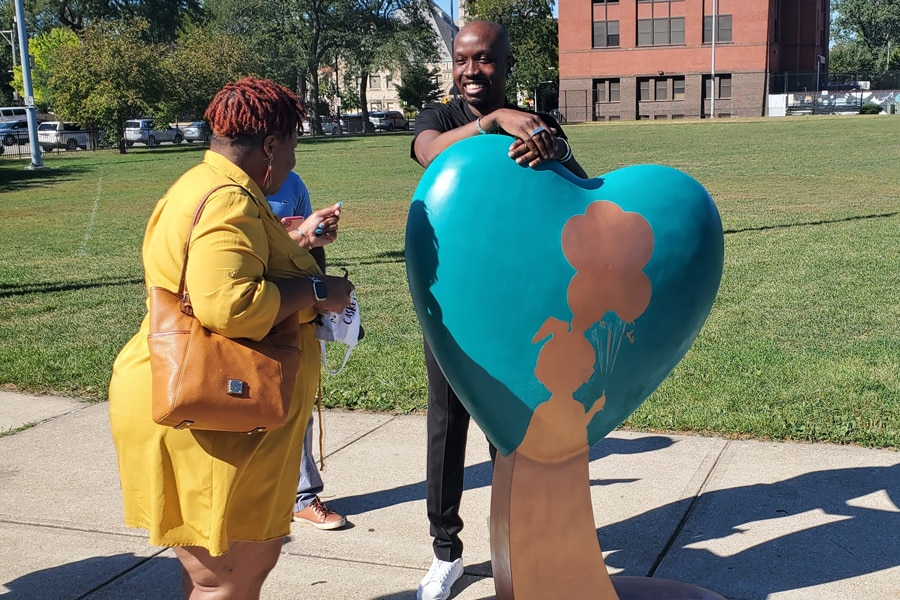
2020 Chicago Peace Fellow Cosette Nazon-Wilburn unveiled ten community-created hearts that will be showcased across neighborhoods in Southside Chicago on September 8th. These five-foot tall fiberglass hearts form the “Parade of Hearts,” a community based initiative designed by the LUV Institute with support from the Chicago Peace Fellows Mutual Aid Collaborative.
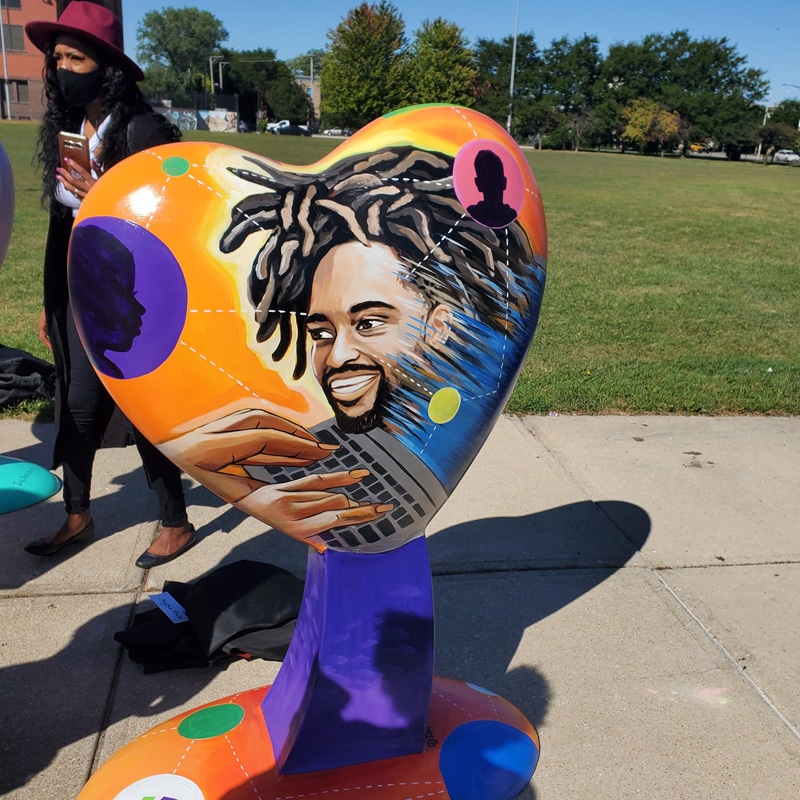
The hearts were collaboratively designed by peace circles in ten neighborhoods: Chatham, Douglas, Grand Boulevard, Greater Grand Crossing, Hyde Park, Kenwood, Oakland, South Shore, Washington Park, and Woodlawn. The peace circles provided an opportunity for the LUV Institute to partner with three other Chicago Peace Fellows: David Gonzalez, Michelle Day, and Jennifer Maddox.
In the peace circles, artists and community members came together and discussed how they would like to showcase their neighborhood’s “new normal” in light of the COVID-19 pandemic and recent political tensions.
Ten hearts were showcased at the launch of the Parade of Hearts; each heart will be placed in a South Side community.
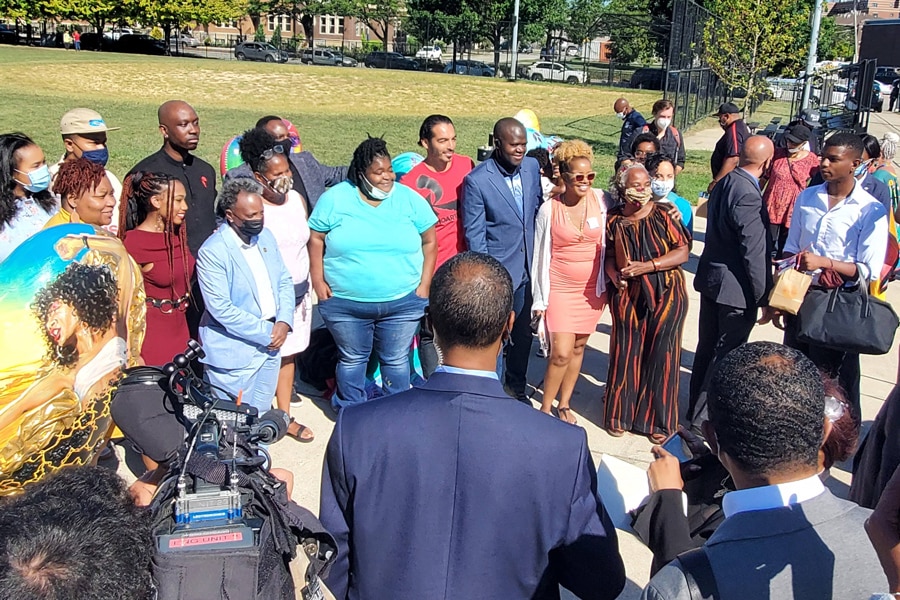
Creating a Parade of Hearts with Communal Visions
Artists acted as community representatives, expressing communal visions of neighborhoods that are beautiful and resilient. One local artist that worked on the project was Damon Lamar Reed, who created hearts for two communities, Nichols Park and Douglas. The heart that he created with the Douglas community is centered around a theme of trust with a man covering a woman’s eyes at its center and a background of stitched patchwork. The patchwork of the heart is meant to evoke memories of mothers patching ripped clothes and making them stronger than they were before. Damon and the Douglas community see this heart as symbolic of their community’s resilience and ability to memorialize the past while creating a stronger community.
Through the parade of hearts, the LUV Institute hopes to revitalize South Side communities through introducing a large-scale public arts project. Cosette emphasizes the importance of bringing arts programs to communities that are often left out of public arts initiatives. The Parade of Hearts aims to act symbolically as an expression of love trumping all, but also to bring prosperity to the featured neighborhoods. She hopes that people will come to visit the hearts and bring tourism to neighborhoods of Chicago that don’t often receive it.
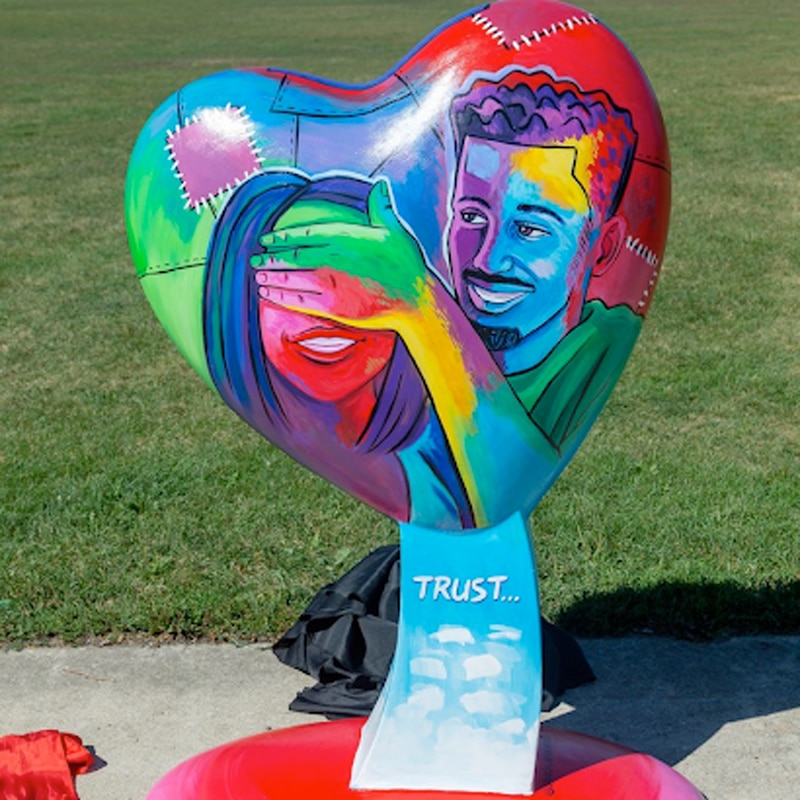
Hearts Will Show that Love Trumps Hate
The process of creating hearts was chronicled by a videographer who will release a documentary talking about the organizations involved in helping neighborhoods design their hearts as well as histories of the neighborhoods themselves. Next year, the LUV Institute will facilitate a digital treasure hunt around the Parade of Hearts, in which people can explore virtual histories of the hearts and their surrounding neighborhoods.
The hearts have started many conversations about peacebuilding in Chicago and many people and institutions have reached out to Cosette, moved by the Parade of Hearts’ message that love can trump hate. For its launch, the Parade of Hearts raised $115,000, surpassing its goal.
The LUV Institute intends to use this money as a seed for a larger community outreach program. Cosette envisions that soon, all 77 community areas in Chicago will be able to create hearts and that money raised through the parade can be used for restorative justice projects. In the future, she plans for the LUV Institute to partner with other local non-profits to launch similar events and initiatives that integrate the arts with community-building and trauma recovery.

Generation Now Helps Teens Produce New Talk Show
By Zeki Salah, Facilitator, Mutual Aid Collaborative
The Chicago Peace Fellows Mutual Aid Collaborative is introducing teenagers to work in the media industry through a project called Generation NOW. Generation NOW was conceived by Messiah Equiano, a 2021 Chicago Peace Fellow, and aims to provide opportunities for young people to work on a teen talk show that addresses everyday issues that teenagers face. The program pays teenagers to produce, direct, and act in the show and provides them with a safe environment to express their thoughts.
Messiah originally thought of the idea of a teen talk show in 2014 and pitched the idea to the television station WCIU. The project was initially based on a show that appeared on BET in the 90s and early 2000s called Teen Summit. Teen Summit provided a platform for teenagers to talk about the everyday issues they face and brought these issues into perspective within an open and safe environment. Messiah thought the idea of a teen talk show was valuable and conceptualized Generation NOW as a similar program that would also allow the young people to get involved in aspects of production.

While the station turned down the pitch, Messiah persisted and applied for a grant from the Chicago Community trust to shoot a pilot episode of Generation NOW. He received the grant from the Chicago Community Trust in 2019 and filmed the pilot at Lawndale Community Academy. This experience showed him how therapeutic and empowering a platform for teens to express their issues could be. Since then, he has been working to secure funding to film more episodes of Generation NOW, including the August 5 filming that was funded by the Mutual Aid Collaborative.

The Mutual Aid Collaborative is made up of 60 Black and Brown leaders and committed allies who live and work in the communities they serve on the South and West sides. They have raised over $86,000 to support several active projects, including Generation NOW. The Mutual Aid Collaborative met and collaboratively voted in May to provide Generation NOW with the funding to film another episode at the Foster Park District.
Generation NOW aims to provide young people with a setting to be open about their opinions, while also providing them with experience with different aspects of television production. Teens are invited to work on the project as writers, production members, or actors and are compensated for their work. On August 5th, the funds provided by the Mutual Aid Collaborative were used to pay 10 teenagers $250 each for their involvement in a day of filming. Funds were also used to provide them with meals and entertainment and also paid for a camera crew. Generation NOW aimed to provide the teens involved with a new opportunity to express themselves without judgment.

The young people were not only provided with food and time to get to know each other, but they were also told not to laugh at each other or dismiss opinions and were assured that the raw footage from the filming would not become publicly available.

The filming of Generation NOW on August 5 was a collaborative effort between Peace Fellows. Alongside Messiah, Nicole Davis and the Talk to Me Foundation brought in actors and rehearsed together. As part of the filming, Nicole and her teens performed a skit where a woman accuses a man of stealing her purse, he denies stealing her purse, and she comes back with her brother to confront the accused man. At the end of the skit, someone approaches the woman and informs her that she left her purse in the bathroom and she apologizes. This scene was modeled after the experiences of the teens themselves, who gave input on how the scene might unfold.

While Nicole led the rehearsal, the script of the conflict and resolution was developed by the teens. For instance, when asked what they would do if confronted about stealing, all of the young men at the filming responded that they would stand their ground during the confrontation and would not run away. The filming not only provided the teens involved with a platform to voice their beliefs without judgment, but also with a chance to enact their visions in a production and to work together collaboratively.

The response of the young people involved in Generation NOW has shown that the program is both therapeutic and empowering. Messiah spoke to the experience of the teens involved as they were provided with a platform to speak about topics like dating and conflict resolution: “Human beings hold onto so much in their hearts and their minds related to their experiences... Even if someone doesn’t express themself, just hearing another person make themselves available can make them feel better.” By continuing to provide this platform for teens and compensating them for their involvement, Messiah believes he can first them away from activities that might lead to violence:
[Generation NOW is about] getting a gun from someone’s hand and a camera into it. I’ve seen this in real life, I’ve seen people love it... you put a camera in his hand and he loves it. You’ve got to give them alternatives and have them get paid for it.”
Messiah’s organization, CHI-RISE, is looking for funding to continue to produce episodes of Generation NOW. They are also looking towards expanding the programs to different communities, and looking specifically at communities with higher risks of violence. Through community collaboration, they are hoping to help teenagers find work on the project during summer and winter recesses from school. Ultimately Messiah hopes to create a sustainable model for Generation NOW by getting members of the community involved and having them watch the show. Through creating content that gives back, Generation NOW aims to create safer and more connected communities.


Mutual Aid Collaborative Discusses How Violence Spreads with Dr. Andrew Papachristos
By Zeki Salah, Facilitator, Mutual Aid Collaborative
On Tuesday, August 23rd, the Chicago Peace Fellows Mutual Aid Collaborative met with Dr. Andrew Papachristos, Director of the Northwestern Neighborhood & Network Initiative. The meeting was part of the Mutual Aid Collaborative Civic Partners Series, which aims to create connections between individuals and organizations that work to build peace and prevent violence.
Dr. Papachristos studies social networks and how they can help activists understand and predict who is at the highest risk of becoming a victim of gun violence. He met with members of the Chicago Peace Fellows Mutual Aid Collaborative, a network of 60 Black and Brown leaders and activists who live and work in the communities they serve on the South and West sides. Fellows came in person and online to strategize with Dr. Papachristos about how they could act to prevent the spread of violence.

Dr. Papachristos’s research around gun violence gave Fellows insight into how the spread of gun violence can be predicted and preemptively addressed. As he presented his research, he made it clear that gun violence primarily spreads through a concentrated segment of the population. This finding suggests that most victims of gun violence either know each other or are linked together by only a few degrees of separation.
To illustrate how gun violence concentrates within particular communities, one section of Dr. Papachristos's presentation focused on how most gun violence injuries within cities affect a small proportion of the overall population. Data collected in Chicago between 2012-2016 showed that more than 70% of all subjects of gun violence are within social networks containing less than 5% of the city population, with 89% of those shootings occurring within a singular network. This insight is particularly pertinent to community activists and local organizations because it allows them to concentrate their efforts in violence prevention on the most vulnerable community members.

The social networks that Dr. Papachristos studies show that people affected by gun violence often share close social ties that have lasting consequences. When members of these networks face exposure to gun violence, it affects measurable aspects of their health, such as stress, sleep, and heart health. Additionally, people within these networks have a higher chance of becoming shot. While the probability of sustaining a gun injury is considerably higher for Black and Hispanic men in Chicago, the likelihood of becoming a victim rises exponentially when those men are in a social network where violence has previously occurred. Dr. Papachristos noted that a Black or Hispanic man between the ages of 14-24 within one of these networks has a higher chance of being shot than someone playing a game of Russian Roulette, in which the odds would be one in six. These figures helped frame the importance of understanding how social networks operate to the Fellows and how Fellows could utilize this information to reach members of the population facing the highest risk of becoming victims of violence.

Dr. Papachristos’s research also illustrated that violence is contagious and that interrupting a potential shooting could have a cascading effect, preventing further instances of violence. He showed how he uses network science to track shootings that chain together within a social network. In Chicago, around 63% of shootings studied occurred within these chains of violence, with an average of 83-120 days between each instance. Each of the moments between these instances represents an opportunity for intervention, when victim services, trauma response teams, or outreach workers could coordinate efforts to stop the further spread of violence. When the number of responders is limited, this information is especially valuable because it helps them make the best use of their time.

As the Mutual Aid Collaborative network entered into discussion with Dr. Papachristos, many Fellows were interested in the root causes that might catalyze a cascade of community violence. Their conversation centered around the effectiveness of poverty abatement, after-school programs, and job programs in preventing future violence. Dr. Papachristos spoke to the need for community activists to take the time to understand root causes while simultaneously engaging in an immediate response to gun violence. He asked Fellows to consider that the average age of a victim of gun violence in Chicago is 27 years old. Examining a root issue such as schooling and primary education would not be doing much for the 27-year-old linked to a network in which gun violence has previously occurred. Systemic problems, such as poverty and education, demand attention, but solutions take time to implement and typically work to benefit future generations. Immediate answers to violence, such as street outreach work, are also needed for prevention.
The conversation between Dr. Papachristos and the Mutual Aid Collaborative network also touched on the importance of narrative when framing incidents of gun violence. Peace Fellows told powerful anecdotes about their work around gun violence and its impact on individual people. For instance, Lisa Daniels, a 2019 Chicago Peace Fellow, spoke about the importance of rewriting the narrative about "offenders" of gun violence. Addressing these narratives allows the "offenders" to understand themselves as victims before their offense rather than viewing themselves as intrinsically violent people. What she claimed is critical in conversations about trauma and healing is that we "remind the individual that they are not the worst thing they have ever done" and consider the “stories victims tell themselves about who they are and what they have experienced." Dr. Papachristos expressed that he tries to capture a similar sentiment in his presentations, referring only to "victims" of gun violence:
Nothing else should matter when you’re trying to save a life.
The meeting between Dr. Papachristos and the Mutual Aid Collaborative network linked rigorous empirical research into the structure of gun violence with the lived experiences of those who work in violence prevention. As community leaders reflected on the data Dr. Papachristos shared and its implications, they also envisioned its potential uses in their own violence prevention projects. A recurring theme throughout the presentation was that there is not a unilateral solution to the epidemic of gun violence, but that different people find different solutions which lift them and members of their communities outside of the cycle of violence. This insight stresses the importance of collaborative action amongst community activists, which the Mutual Aid Collaborative aims to facilitate. It is critical for grassroots partnerships to be created to provide individuals caught within networks of violence with a range of resources that can suit their diversity of needs.

Safety Net Launches Blood Drive
By Zeki Salah, Facilitator, Mutual Aid Collaborative
Chicago Peace Fellows are working to address an increased demand for blood from Black and Brown donors through holding a Mutual Aid Collaborative Blood Drive. The Blood Drive is part of an ongoing Safety Net project by the Chicago Peace Fellows Mutual Aid Collaborative, a group of 60 Black and Brown leaders and committed allies who live and work in the communities they serve on the South and West sides. Fellows working on the Safety Net project seek to address multiple pandemics that ail the South and West Sides of Chicago, including COVID-19 and community violence.

The Safety Net campaign is accepting donation pledges until June 28th, but you can donate at any time after making the pledge. You can sign up for the Safety Net team’s blood drive here: https://sleevesup.redcrossblood.org/campaign/give-from-the-heart/
You can also promote the blood drive by using the hashtag: #OurBloodMatters
The Safety Net project started at the height of the COVID-19 pandemic by creating a distributed network of PPE providers throughout a grassroots network, but has since expanded its scope to include broader public health issues. Since its inception, the Safety Net project has also held COVID vaccine clinics to address the disproportionate impact of COVID-19 on Black and Brown communities. The Chicago Peace Fellows Blood Drive is the latest project by the Safety Net team and seeks to address a shortage of Black and Brown blood donors.

More Black and Brown donors are needed in the United States because of a rise in demand for some rare blood types that are more common in people of Black heritage. Certain subtypes of blood need to be matched to treat blood diseases such as sickle cell anemia. Blood donors are screened to see if they might possess certain rare blood types, which can also help match plasma and bone marrow donors. The demand for blood that the Safety Net team seeks to address is expected to increase even more during the summer, due to the increase of accidents such as car crashes and fireworks, as well as spikes in cycles of gun violence. This can put patients who need blood in consistent quantities at risk as these sorts of incidents risk depleting the blood reservoir that their treatments draw from.
The Safety Net wanted to bring attention to the need for a more diverse blood bank after learning that the director of the Chicago Peace Fellows, Burrell Poe, was diagnosed with aplastic anemia. Treatment for aplastic anemia requires bone marrow transplants, which can only be performed if the donor and recipient have matching subtypes of blood. In solidarity with Burrell, the Safety Net team scheduled their Blood Drive around his birthday, so that members of the community could be made aware of the importance of blood donations and their potential to transform the lives of other people.

Jacquelyn Moore of the Safety Net team donated blood in response to the blood drive and found the experience to be fulfilling as an altruistic act, while also gaining new insights into her own health. Jackie was touched by the campaign on a personal level because a blood drive saved her husband’s life after it connected him with a match for a stem cell transplant. She stated “giving blood provides a way to directly help the community and provides people with an opportunity to act, to improve the lives of people around them.” Additionally, Jackie noted the pragmatic benefits donors receive when giving blood. After giving blood, she was contacted by the Red Cross and given a report of her COVID-19 antibodies. She noted that the Red Cross also provides other reports on other aspects of the health of its donors and can act as a free health screening. At the screening, vital signs are checked and problems such as high blood pressure, arrhythmia, or low hemoglobin levels can be detected.
The Safety Net team’s blood drive campaign also seeks to dismiss myths about giving blood. They assert that giving blood is not painful, and can even be relaxing as it gives the donor an opportunity to sit back and take a break from the hustle and bustle of the day. Additionally, the Safety Net encourages members of the LGBTQ+ community to explore the possibility of giving blood, because many of the previous restrictions against donors within this community have been lifted. Lastly, the Safety Net team emphasizes the safety of giving blood, donation centers undergo strict COVID precautions and there is a low risk of contracting COVID while giving blood.

Second Annual Chicago Peace Fellows Music Festival
By Zeki Salah, Mutual Aid Collaborative Facilitator
The Chicago Peace Fellows held a Concert for Peace on June 4th, celebrating the artistic accomplishments of their communities and a shared commitment to improving their neighborhoods. The Second Annual Chicago Peace Fellows Music Festival was held at the Hatchery in Garfield Park with Peace Fellows gathering performers from across the city to play music, sing songs, read poetry, and dance. The Music Festival was organized by a committee within the Peace Fellows Mutual Aid Collaborative, a group of 60 Black and Brown leaders and committed allies who live and work in the communities they serve on the South and West sides.

The event was made streamed live on the Goldin Institute’s Facebook page where you can watch the recording.
The Music Festival Committee is made up of musicians and educators that have first hand experience with the transformative power of music and its positive impact on communities. The committee pooled their connections to create a lineup with a diversity of talents that represented neighborhoods across the city. The Peace Fellows Music Committee is made up of Peace Fellow Alumni from across the cohorts of 2019, 2020 and 2021: Gloria Smith of the Black Star Project, Angelina Zayas of the GAP Center, Juliet Jones of the Original 64th Street Beach Drummers, Margaret Murphy-Webb of the South Side Jazz Coalition, Marvinetta Penn of Global Girls, Inc., Rashada Dawan of B.Fli Productions, and Robin Cline of Neighborspace.
As musicians, artists, and educators, members of the committee had an eye for both talent and opportunity, bringing together talented members from their communities to perform. Many of the performers at the Peace Fellows Music Festival were young people for whom the festival provided an opportunity to gain experience performing, show off their talents, and be compensated for their time and effort. Additionally, by bringing together artists from across the city, the Peace Fellows Festival allowed for them to network with each other and collaborate in their artistic ventures.

The Peace Fellows Music Festival featured an eclectic range of performances, including jazz, hip hop, and classical music, as well as spoken word poetry and choreographed dances. Finding talent for the Festival was a collaborative effort, with multiple organizations spreading the word and connecting talent to the festival.
Performers included:
- Guru Tonic
- Heart Cry
- Kenya Braitwaite
- Mara Mitchell
- Global Girl Youth Company
- Phoenix
- The Original 64th Street Drummers
- Margaret Murphy-Webb
- MC Skool
- Ethan Clay
The Festival was held at the Hatchery, a non-profit food and beverage incubator which provided the space for free. While the Hatchery primarily serves to provide professional development to people in the food services industry, both the Hatchery and the Peace Fellows involved in the Festival have a common goal of connecting underserved communities with access to education, opportunity, and community resources.

The theme of peace was emphasized throughout the Festival as performers and organizers spoke to the importance of arts education, mutual aid, and community activism. Peace Fellows and their organizations were invited to set up tables and share information about their organizations for the first hour of the festival. This allowed for Fellows representing neighborhoods throughout Chicago to share resources with each other and network.

As the concert came to a close, 2020 Chicago Peace Fellow, Maragret Murphy-Webb, spoke to the importance of investing in arts education. She emphasized that the arts have the capacity to improve communities and combat violence: “If you put an instrument in a child’s hands, you can keep a gun out of their hands.” She encouraged audience members to engage with the City of Chicago and request more funding for arts and education in the South and West Sides so that underserved neighborhoods might have greater access to educational opportunities.

Through bringing together community members, providing them with opportunities, and affirming a collective commitment to peace through music and art, the Peace Fellows Music Festival sought to improve the communities represented by the Chicago Peace Fellows. Fellows’ commitment towards representing and improving their neighborhoods was pivotal to the Festival’s success.

Connecting Community Members with the Research of the University of Chicago Crime Lab
By Zeki Salah, Facilitator, Mutual Aid Collaborative
Chicago Peace Fellows hosted a conversation at the Firehouse Community Arts Center on June 3, 2022 to discuss community safety and crime data with the University of Chicago Crime Lab. The event was held as part of the Mutual Aid Collaborative’s Civic Leaders series, which is designed to connect alumni of the Chicago Peace Fellows with policy makers, academics, and community activists that are leading innovative work to promote community safety and prevent violence in their neighborhoods.

At this event, the Peace Fellows met with Kim Smith, the Crime Lab’s Director of Programs, to learn about data that the Crime Lab collects and how it has been used to shape policy decisions. Members of the Lawndale community also came to attend the presentation and learn about how they can engage with the Crime Lab’s research.

The Crime Lab’s presentation focused on the disproportionately high rate of gun violence in Chicago as well as the disproportionate impact of this violence on communities of color. In 2020, there was an increase in violence crimes, and homicides in particular, in Chicago. While other large cities such as Los Angeles and New York have lowered their homicide rates, Chicago’s rate of homicides has increased from 2010-2020. This violence also affects men of color more so than any other group: 80% of shooting victims in 2020 were Black and 86% were male. Black men also carry a dual burden of incarceration alongside gun violence victimization, with the percentage of Black men aged 20-24 being over five times greater than the percentage of white men of the same age group.

Peace Fellows, the Crime Lab, and other members of the community spent much of their time together talking about the causes of this disproportionate violence and potential solutions. The Crime Lab noted that the majority of homicides were not motivated by money, gang interests, or other instrumental purposes, but were spurred by personal altercations between individuals. Members of the community attributed some of the causes of the increase in violence to the way incarcerated people are rehabilitated and to increased absences in schools after the outbreak of the COVID-19 pandemic. Community members and Kim Smith of the Crime Lab mutually agreed that street outreach workers who work at personal level with community members are often successful in addressing these kinds of personal altercations and that there is a need for funding in this area.

Meeting together helped Peace Fellows build connections between their own experiences and the data captured by the Crime Lab. In their presentation, the Crime Lab showed that 16,000 children became disengaged during the pandemic. Pamela Montgomery-Bosley began working as a violence prevention manager with youth after her son was shot and killed and spoke to her experience working with children in unstable homes. She spoke to her experience seeing children struggle with their home lives while finding some stability at school, but noted that schools are now having difficulty keeping children in classrooms. Kim supported this argument by citing Crime Lab data that over one in nine children in options schools, which are largely composed of students who were previously disengaged from school, have been involved in violent incidents. She also noted the increased rate of victimization and arrests amongst option schools students.
Meeting with the Crime Lab showcased to Peace Fellows how data can give deeper insight into the disproportionate levels of violence in communities of color. Data can support personal experiences around issues such as violence and disengagement in school, giving them greater weight. This can enhance communications, donation campaigns, and grant proposals for grassroots organizations in need of resources. Kim encouraged Peace Fellows to request data from the Crime Lab to supplement their own work, noting that even if the Crime Lab does not have data around specific issues, a request could help direct future research.
The meeting between Peace Fellows and the Crime Lab worked to bridge the gap between the research of the Crime Lab and the members of the communities they study. Kim Smith noted that the Crime Lab often has difficulty connecting with grassroots leaders and sharing its data and that they are looking for ways to engage more with local communities. By connecting with the Peace Fellows, the Crime Lab will be able to better share its research and direct its focus towards interests that are guided by community input. This in turn will help the Crime Lab provide community members with a deeper understanding of the problems they are facing and offer potential solutions to the spread of violence.

Generating food, beauty and safety for neighbors in Chicago
By Yusuph Masanja, Co-Facilitator, Global Alumni Network
Goldin Global Fellow from Chicago, Robin Cline, serves as Assistant Director of NeighborSpace, the only nonprofit land trust in Chicago that preserves and sustains gardens on behalf of dedicated community groups. NeighborSpace has helped neighbors and community groups protect over 120 outdoor sites, transforming them into places where people gather to play, to grow food together, and to organize around issues in their neighborhood.

NeighborSpace continues to help community groups identify outdoor sites that can be turned into community garden spaces. They partner with early community organizations, early childhood teachers, seniors, and families in turning potential unused sites into gardens and creative gathering spaces. Especially now in the time of COVID, these outdoor spaces are more and more used as places for free haircuts, food distributions, COVID tests, and community meetings.
NeighborSpace continually works to support more growing and gathering space, and you can help with this New Year’s goal of adding 100 garden beds to NeighborSpace sites across Chicago, by visiting this Crowdfunding page to help NeighborSpace reach this goal before the 2021 growing season.

For Robin, the motivation to dive into this work comes from the goal to encourage urban people to reconnect with nature, themselves, and their community. Robin believes that if you set the right conditions for people to understand a series of processes, like that of a plant ––from seeds to fruits––it helps them understand the importance of how connected we are.
"How can we create opportunities for people to have physical connections to shared public spaces that then prompt them to have in-person connections with their neighbors?"
/Robin has recently graduated from the Visual Collaboration course which was offered by the Bigger Picture Academy. Having been inspired by this collaboration tool, she is considering applying it to support processes by which the garden leaders conduct their community building vision. Robin is mobilizing resources to provide these leaders with access to computers and the Mural application in order to learn and start using Visual Collaboration methods.

Furthermore, Robin finds inspiration from the stories of Goldin Global Fellows. The stories motivate her to keep up the good work despite challenges faced from time to time.
"Hearing other people’s stories of salvation and struggle fuels the work I am doing. We are doing non-profit work that sometimes feels invisible."
Robin adds: "The sharing of stories is so 're-storying' which is so restorative, I feel like that's an important part of the Goldin Global Fellows connection- to support each other in serving others."