
Donate

With the power of your donation and commitment, we are one step closer to our shared vision and mission!
Giving to the Goldin Institute is an excellent way to empower communities around the world to solve critical issues. The Goldin Institute's core costs such as offices, supplies and staffing are already underwritten, so your tax-deductible donation will go directly to community-driven projects:
- Combating gender-based violence in Haiti.
- Providing access to safe drinking water in the Philippines.
- Making microcredit work for recipients in Bangladesh.
- Preventing the recruitment of children in conflict in Colombia.
- Building a National Partnership for Child Soldiers in Uganda.
- Supporting the next generation of grassroots activists through Leadership Development.
- Expanding our network of Global Associates.
As we continue working towards our shared mission, we ask you to become a champion of the Goldin Institute by:
- Making a Donation! Become a sustaining member of the Goldin Institute by making a tax-deductible donation on-line using the form to the right!
- Spread the Word! Please support us in expanding our network by forwarding our website and materials and encouraging your friends to join us on Facebook and Twitter.
- Become Further Engaged! We ask for your passion, your time and your energy as we lead the development of new models for global solutions. Please contact us about opportunities to get involved.
The change we wish to see in the world can only be achieved if we all work together. We can only grow with your support and commitment.
Thank you for helping to make real change in the world!

Help us Expand Online!
Many organizations work on issues of poverty alleviation, environmental sustainability, women's leadership and conflict resolution. What sets the Goldin Institute apart is our community-driven approach. Help us expand online so we can expand our work on the ground.
Join our Newsletter
We send a periodic newsletter to grassroots champions like you! We promise to not load up your inbox with anything but the good stuff and generally send one message or less per month. And as always, you can unsubscribe at anytime (but we don't think you'll want to)!
Join us on Facebook
The Goldin Institute has a robust and growing community on Facebook. Join the movement by "liking" the Goldin Institute to receive our daily updates on our projects, important news and to participate in the discussion. You can help expand the growing community of people committed to grassroots partnerships for global change by inviting your friends and colleagues to get engaged.
Add Your Voice on Twitter
Join us on twitter @goldininstitute to be sure to receive up to the minute announcements and coverage of the issues we are working on including poverty alleviation, conflict resolution, women's leadership and envirnomental sustainability. You can play a crucial role by using twitter to bring important news and events to our attention.
Learn More on YouTube
Watch the latest videos documenting the work of our partners around the world by visiting our YouTube site. If you are interested in learning more about what effective grassroots partnerships look like, this site includes a collection of short videos highlighting community-driven social change initiatives around the world.
Schools as Centers for Reconciliation in Colombia
For over forty years, a civil war has raged in Colombia between the central government, leftist opposition groups and more recently armed paramilitary groups. While accurate counts of the number of children involved in combat are not available, many experts believe that approximately 10,000 child soldiers are still active in Colombia today despite the demobilization of thousands.
In response, the Goldin Institute is working with local partners in Colombia to build upon the success of the National Partnership for Child Soldier Reintegration and Prevention launched in 2007. This National Partnership engages social, private and public sector agencies to prevent the victimization of vulnerable young people in armed conflict, builds the understanding and commitment within the nation to welcome exploited young people back into communities and provides skills, services and connections necessary for former child soldiers to reintegrate into society.
History of the Project
The use of child soldiers and young combatants in armed insurgencies, militias and resistance movements is a staggering and growing problem in regions as diverse as The DR Congo, Sri Lanka and Colombia. Well over 300,000 young people under the age of 18 are currently fighting in wars or have recently been demobilized. At the same time, the number of children emerging from these traumatic circumstances has dramatically increased.
Many of the communities in the Goldin Institute's global network are working to reintegrate former child soldiers and prevent their conscription into the fighting in the future. How can our communities help young combatants leave the fighting? How can former child soldiers receive the services and support they need to reintegrate into society? What are the roles and responsibilities of different sectors—education, business, government, religious communities, NGO's and others—in providing these services? How can we work together to make sure our society is ready to welcome home these former combatants? How can we work together at home and around the world to break this cycle of violence and prevent the exploitation of young people by armed groups and militias?
To explore and answer these questions, the Goldin Institute partnered with the Centro Mundial de Investigacion y Capacitacion para la Solucion de Conflictos (Centro Mundial) to convene a global forum on the theme of Reintegration & Prevention: Breaking the Cycle of Violence for Ex-Combatants and Vulnerable Children and Youth. This unique gathering brought together teams of engaged leaders struggling to address these issues from over twenty cities in Bosnia and Herzegovina, Brazil, Cuba, Colombia, DR Congo, El Salvador, Haiti, Israel, Kenya, Liberia, the Philippines, Rwanda, Somalia, Tanzania, Uganda and the United States.
The forum also served as a catalyst to promote the launch of a National Platform in Colombia to engage social, private and public sectors throughout the country to promote co-existence, reconciliation and peace-building efforts. This National Platform continues to serve as a leader in the efforts to reintegrate former combatants by providing the skills, services and connections necessary to re-enter Colombian society. The National Platform is also leading groundbreaking efforts to prevent the victimization of vulnerable young people in armed combat and in building the understanding and commitment within the nation to welcome exploited young people back into society.
In September 2010, we partnered with Dr. Ceasar McDowell of the M.I.T. Center for Reflective Community Practice and Fr. Leonel Narvaez of the Fundacion para la Reconciliacion in Colombia to help address the crisis of young people used as combatants. This visit enabled our Colombian partners to adapt and use the "Critical Moments Reflection Methodology" developed by Dr. McDowell to uncover, understand, and document knowledge held by participants in the Schools of Forgiveness in Colombia.
In 2012, the Goldin Institute deepened its partnership with the Foundation for Reconciliation to pilot a groundbreaking new curriculum in six schools focused on preventing the recruitment of young people into armed conflict. The "Pedagogy of Care and Reconciliation" engages students not only in peace-building, reconciliation and facilitation skills, but also encourages schools to become centers of shared learning and development for the entire community.
In 2014 we refinined and expanded the reintegration tools learned in Colombia through cross-training workshops with our partners in Uganda.

Improving Microcredit in Bangladesh

In the efforts to address poverty, the voices of those impacted by economic insecurity are too often conspicuously absent. The Goldin Institute's work builds on the experiences and perspectives of those living in poverty and designs solutions based on their knowledge, strategies and aspirations.
Through the Goldin Institute's pioneering work on Community-Based Oral Testimony in Bangladesh, we are building new ways to improve poverty alleviation strategies, especially microcredit, from the perspective of the poor.
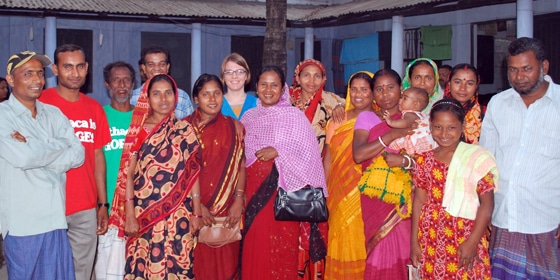
The current debate about the efficacy of microfinance is marked by the absence of those who have most at stake in the controversy: loan recipients. The Goldin Institute is working to lift up these voices, most often marginalized women, and restore their perspectives, insights and aspirations to the discussion.
We invite you to review the links on the right side of this page to learn more about the Goldin Institute's work on poverty alleviation in Bangladesh and around the world.
Solving the Water Crisis in the Philippines

While the specific environmental concerns change based on geography, one of the issues of broadest concern across our global network is the lack of access to safe drinking water. Today 1.1 billion people live without access to safe drinking water.
Eighty percent of illnesses and deaths in the developing world are attributable to water-borne diseases. With the population continuing to grow and renewable water resources being depleted, this crucial issue is becoming an increasingly urgent concern.
Physical and Economic Scarcity of Water
Physical access to water is limited. When demand for water outstrips the lands' ability to provide, there is physical scarcity. For the most part, dry parts of the world or arid regions are most often associated with physical scarcity. However, there are an increasing number of regions in the world where physical scarcity is a man-made condition. The Colorado River Basin in the United States is an excellent example - a seemingly abundant source of water is overused and over-managed, leading to rivers running dry.
Economic water scarcity exists when a population does not have the necessary monetary means to utilize an adequate source of water. It is about an unequal distribution of resources for various reasons, including political and ethnic conflict. Much of sub-Saharan Africa suffers under the effects of this type of water scarcity.
Without question, economic water scarcity in an issue that can be addressed quickly and effectively. Access to clean water can be as simple as building small dams to catch rain water, or rain collection systems to collect rain from rooftops. It simply takes some money, a bit of engineering and some local construction efforts.
Water Access is a Human Right
Many understood human rights cannot be realized without the prerequisite of water.
- Right to life: Without water, no life can be sustained.
- Right to adequate standard of living cannot be realized without a secure access to water
- Right to education: The lack of proper supply of water forces children to walk long distances, often several times a day - thus missing school - to provide their families with water.
The right to water is indispensable for leading a life in human dignity, but often denied in developing as well as developed countries.
Child Soldier Reintegration in Uganda
The Goldin Institute is honored to work with a wide range of community leaders and partners from a broad range of civil society experts to promote reconciliation and peace building around the world. Of particular concern is the use of child soldiers in conflicts throughout our network.
In places like Colombia, Uganda and the Philippines, the Goldin Institute is working to build broad-based, community-driven coalitions to prevent the use of young people in combat and reintegrate former child soldiers.
Child Soldier Reintegration and Prevention
 The international community defines child soldiers as persons below the age of 18 who are involved with the armed forces, both during times of peace and conflict. Currently, there are 86 countries that use child soldiers and it is believed that at any given time, there are 300,000 child soldiers involved in battles worldwide. While the number of conflicts in which child soldiers are involved has decreased from 27 in 2004 to 17 in 2007, there is evidence that the decrease is more strongly tied to the end of conflicts than to the effects of legislation. While efforts to prevent the use of child soldiers has intensified in the last decade, it continues to be an issue that demands attention as more children are drawn into conflicts that cause them to lose their childhood.
[quote]I would like you to give a message. Please do your best to tell the world what is happening to us, the children. So that other children don't have to pass through this violence. -15 year old child soldier from Uganda in an interview with Amnesty International[/quote]
Reasons for Joining the Armed Forces
While there are many reasons offered for why children join the armed forces, the thread that links all of the reasons concerns issues of survival. Although children who enlist in the armed forces of their own accord are seen as voluntary participants, there are economic and social factors that largely influence their decision. One reason that is often mentioned for voluntary enlistment is the economic pressures felt by the children's families, as poor families are often unable to support their children and provide them with food and education during times of war. Families in this situation often reason that the best alternative for children is to join the armed forces, where they will be provided with food every day. Street children often join because they see no other positive alternative, as they have no family and live each day in uncertainty. Others who join the armed forces seek to avenge the deaths of their relatives, by fighting in opposition to armed forces that killed them. Girls occasionally use the armed forces as an escape route from domestic servitude, enforced marriage, and abuse at home. Despite "voluntary enlistment" by children, armed forces often continue to forcibly remove children from their homes to join their ranks in the face of clear resistance from children and their families.
Duties of Child Soldiers
Once recruited into the armed forces, children face a variety of duties, which includes participating in combat, laying explosives, deactivating mines, spying, training, cooking, and engaging in sexual activity. While girls are most often recruited for sexual purposes, they also take part in other duties that are often more strongly associated with boy soldiers by the international community, such as combat.
The Issue of Girl Soldiers
While the plight of boy child soldiers is highlighted internationally, recent reports suggest that 40% of all child soldiers are girls, which brings issues of girl child soldiers to the forefront. Although boy and girl child soldiers have similar duties for the most part, girls have the added strain of being forced to engage in sexual activities with commanders of their units. While some girl soldiers have stated in interviews that their commanders protect them from receiving harsh punishments while serving in the armed forces, the psychological damage that results from underage girls being forced to engage in sexual relations with commanders is overwhelming. Besides psychological damage, there is also a high risk of girl soldiers getting sexually transmitted diseases through sexual contact with commanders.
This issue becomes most problematic when considering post-war implications. While reintegration programs are becoming more prevalent in countries that use child soldiers, the fact remains that thousands of girls continue to be on the short end of receiving reintegration support. One reason that girls are not as involved in reintegration programs is because they do not want to be identified as child soldiers, for fear of being rejected by their families for engaging in sexual activities as soldiers. Furthermore, girls in some conflicts are not allowed to take part in reintegration programs, as they are held back by commanders who have forced the girls to become their wives. Also, because reintegration programs are largely targeted toward boy soldiers, the needs of girl soldiers are often not addressed in terms of the necessary psychological and physical check-ups. Reintegration programs also run into problems on how to re-integrate girl soldiers, because programs that revolve around reintegration into families and communities will not be effective for girls who joined the armed forces to escape their families and communities in the first place.
As the number of girl soldiers recruited into armed forces continues to rise, it is becoming increasingly important to recognize and address their experiences. Although they have similar duties to boy soldiers, there is a large enough difference between their roles that programs need to be created that address the needs of girl soldiers if they are to be successfully reintegrated into society.
Ending Gender-Based Violence in Haiti

The Goldin Institute believes in the power of communities coming together to build their own solutions and determine their own futures. Key to our achieving our mission is ensuring that voices and perspectives that are often excluded from the discussion—often women—are heard and included.
From combatting gender-based violence in Haiti to improving microcredit in Bangladesh, women-led, community-based projects are integral to the Goldin Institute's work around the world.
Rape Accountability and Prevention
 The Haiti Rape Accountability and Prevention Project (RAPP) is designed to respond to the epidemic of rapes against poor women and girls in Haiti in the wake of the Jan. 12, 2010 earthquake. The program includes four closely integrated components: legal advocacy, healthcare, organizing, and public advocacy.
RAPP provides individual victims of sexual assault the legal services they need to obtain justice and compensation, while working with allies in Haiti and abroad to transform the social context that underlies the vulnerability of all poor Haitian women to assault. The Project also aims to deter future rape by punishing the perpetrators and forcing a more effective response by law enforcement and the justice system.
Bangladesh: Restoring Recipient Voices to Improve Microcredit

The current debate about the efficacy of microfinance is marked by the absence of those who have most at stake in the controversy: loan recipients. The Goldin Institute is working to lift up these voices, most often marginalized women, and restore their perspectives, insights and aspirations to the discussion.
Based on our innovative Community Based Oral Testimony methodology, where villagers in Bangladesh interviewed their neighbors about their experiences as loan recipients, we have helped capture and document these voices and are hard at work to ensure that they are heard in Bangladesh and around the world.
This community driven research raises many questions about the claims of gender empowerment made by microcredit supporters. In the words of Kohinoor Begum, Community Researcher and loan recipient herself:
[quote]Generally, credit is given in the name of the woman. The credit agencies do not grant credit if there is not a woman residing in the household. This is why male members of our homes or husbands sometimes force us to take credit. But, if we take credit, we have to hand it over to our husband or father-in-law who uses it in any way he wishes." [/quote]
Kohinoor went on to testify to the hidden perils that women like herself have experienced due to the misuse and exploitative practices taken by the lending institutions and the men of the communities in the rural villages where we conducted our research:
[quote]But, the NGO employees come to recover the money from us (women) and we have to face many insults and indignities ... It is the men who spend the money. But, payment of installment is sought from the women. We talk of women before all and talk of empowerment, but women are used within the traps and labyrinths of micro-credit. Women are deprived of their rights. Since women have begun taking micro-credit, oppression on her has multiplied. The evil practice of dowry became manifold. Because of micro-credit, social solidarity in villages is at stake." [/quote]
- Kohinoor Begum, Community Researcher

Alone and Frightened: A Summary of our Report
 In the discussions about disarmament, demobilization and reintegration of children used as soldiers in the conflict in Northern Uganda, the voices and perspectives of former child soldiers themselves have too often and too long been ignored.
 In the discussions about disarmament, demobilization and reintegration of children used as soldiers in the conflict in Northern Uganda, the voices and perspectives of former child soldiers themselves have too often and too long been ignored.
To restore these voices to the discussion and to improve the services for former combatants, the Goldin Institute and local partners trained a group of former child soldiers in "Community Based Oral Testimony" as a tool for gathering these stories and perspectives. Through this project, former child soldiers themselves led the research collection through interviewing over 150 of their peers and together reflecting on common concerns and shared aspirations.
The results of this groundbreaking research are contained in the report, Alone and Frightened. Equipped with this knowledge and the sense of solidarity developed through the research process, the former child soldiers are now at the forefront of convening the National Platform for Child Soldier Reintegration in Uganda as a network for coordinating the work of NGOs, government agencies, religious communities and other partners who are working together to promote reconciliation and reintegration.
[quote]Child Soldier definition: A child soldier is one under the age of 18 and part of a regular or irregular armed force or armed group participation directly indirectly. Child soldiers perform a range of tasks including combat, laying mines, and explosives; scouting, spying, acting as decoys, couriers or guards; training, drill or other preparations; logistics and support functions, pottering, cooking and domestic labor; and sexual slavery or other recruitment for sexual purposes."[/quote]
- UNICEF 2003
 This study describes the state of children affected by the brutal war in Northern Uganda pitting the Lord's Resistance Army (LRA) against the Uganda People's Defense Forces (UPDF). These are stories of Former Child Soldiers (FCS), please use your discretion as these stories are both horrific and heart-rendering.
The study sought to achieve the following objectives:
- To facilitate a platform for FCS to share their experiences and challenges of abduction and escape from captivity.
- To establish the community and family perceptions and attitude towards FCS.
- To identify gaps in the implementation of the Cessation of Hostilities/Juba Peace Agreement (CHA) (2006), agenda item V on DDR, the institutional mechanisms and the current state of FCS with regard to DDR.
- To establish and highlight the locally-generated and FCS-based frameworks for reintegration.
- The content scope of this research was to document and analyze the experiences and challenges of FCS with regard to their reintegration into families and communities within the CHA broader agenda item V.
Design:
A total of 180 primary informants were purposely selected out of 264 interviewed using the principles of participatory feedback and primary respondent-centered ownership of the research. Of respondents, 52% were male, and 48% were female.
Key Findings:
Females seemed more unwilling to respond to the the participation due to fear of being identified, fear of community reprisal or, a manifestation of inadequate or lack of psycho-social support.
- The majority of children abducted (58.9%) were 15 years of age and below, a clear indication of loss of childhood including schooling for many, in addition to horrifying traumatic experiences.
- Major health issues were identified among FCS including bullet wounds and fragments in the body, septic wounds, fistula, HIV/AIDS and cardiac problems.The physical scars or bullets lodged in their bodies has rendered some of them unable to find spouses or fend for themselves.
- Of the 87 females interviewed, 39 returned as child mothers.
- While 60% of the abducted children found themselves in the hands of Uganda People's Defense Forces (UPDF) and later reception centers, many (40%) did not receive initial counseling and support. Many experienced constant death threats, spiritual initiation rituals ranging from sitting on dead bodies to having sex with an older person, lasting 1-6 years in captivity. Thus, one can understand the extreme levels of trauma and lack of livelihoods among FCS currently.
- Large portions of FCS expressed concerns of psychological suffering and/or trauma as a result of their experiences in captivity, including but not limited to, nightmares, anxiety and fits of anger, as well as alienation, appropriation, dispossession, guilt, loneliness, and poor relation with others (aggression, shouting, commanding, etc.).
- Over half found either one or both parents dead. This means a sizable number returned as orphans, with a greater number losing their fathers.
To learn more about the next steps and the multi-sector network promoting reintegration and reconciliation, click here to read about the work of the National Platform for Child Soldier Reintegration and Prevention in Uganda.
The following slideshow includes recent ESPERE workshops featuring our colleagues in Uganda and Kenya. Many of the participants represent the aspirations detailed in the Alone and Frightened Report.
[slide] [img path="images/slideshow/full/uganda2014_1.jpg"]Co-founder's Diane Goldin and Travis Rejman meet with Everest Okwonga, the Principal at St. Janani Luwum Vocational Training Centre[/img] [img path="images/slideshow/full/uganda2014_2.jpg"]Co-founder's Diane Goldin and Travis Rejman meet with students at a trade school for former child combatants in Gulu[/img] [img path="images/slideshow/full/uganda2014_3.jpg"]Co-founder Diane Goldin meets with students in a Gulu classroom during the Institute's June2014 trip to the region to take part on child soldier reintegration efforts[/img][img path="images/slideshow/full/uganda2014_4.jpg"]Participants of a workshop conducted by Global Associate Lissette Mateus Roa take part in one of the exercises teaching 'forgiveness'[/img][img path="images/slideshow/full/uganda2014_5.jpg"] Global Associate Lissette Mateus Roa (bottom left) and her group of ESPERE students. Also included is friend and colleague and Associate emeritus Dr. Dorcas Kiplagat (standing 5th from right)[/img] [img path="images/slideshow/full/uganda2014_6.jpg"]Participants of the ESPERE workshop during a training session[/img][img path="images/slideshow/full/uganda2014_7.jpg"]Global Associate Lissette Mateus Roa (standing) leads a training session in Gulu[/img][img path="images/slideshow/full/uganda2014_9.jpg"]Global Associate Lissette Mateus conducts an exercise with participants of the ESPERE workshop in June 2014[/img][img path="images/slideshow/full/uganda2014_15.jpg"]Global Associate Lissette Mateus (sitting foreground) leads her ESPERE training group[/img][img path="images/slideshow/full/uganda2014_28.jpg"]Co-founder Diane Goldin meets with students at the St Janani Vocational School. The School is made up of mostly former child soldiers learning new skills (like carpentry in this classroom) to rejoin civilian life.[/img] [img path="images/slideshow/full/uganda2014_27.jpg"]The workshop attended by former child combatants[/img][img path="images/slideshow/full/uganda2014_34.jpg"]Institute co-founder Diane Goldin meets with Ajok Dorah - a psychologist specializing in giving counsel to former child combatants returning to their communities.[/img][/slide]
